Poling the Okavango: The Tell Before the Hippo
A lemur and chameleon guide from Madagascar reads a poler's ngashi and a heron's flinch through the Okavango Delta's flooded channels.

The Boro Launch Channel
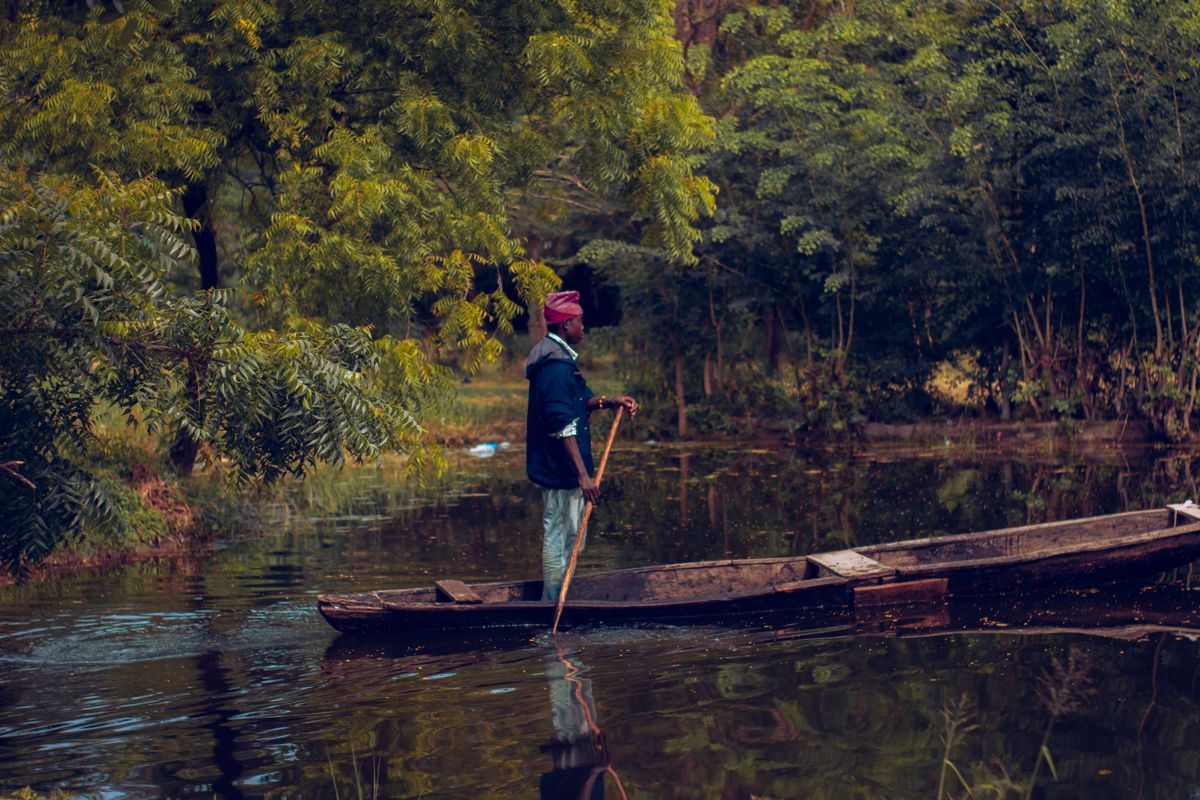
Not our channel or our poler, but the same punting technique: pole planted and pushed against the bottom, not paddled through the water.
Specimen observed: adult male, mid-forties, sun hat still holding the crease from its packaging, dressed head to foot in a khaki that matched nobody's actual bush kit, least of all mine. Behaviour: readjusting his camera strap for the fourth time in ten minutes, checking the other boats sideways to see whose life jacket looked more competent than his own. Tell: the moment our poler pushed off from the reed bank at Boro, the fidgeting stopped cold. A stillness that complete, in a man who had not stopped moving since the vehicle pulled in, is its own kind of confession.
The launch site at Boro runs a dozen mokoros deep some mornings, prows nosed into the mud in a row like resting animals themselves, guides sorting day bags and life jackets while egrets picked through the shallows nobody had disturbed yet. Ours was third in line. The water underneath, once we pushed off, ran the colour of strong tea, clear enough near the surface to watch reed stems bend sideways in a current I couldn't otherwise see.
The mokoro itself sits lower in the water than I expected from photographs, a dugout canoe barely wider than my hips, riding the surface with maybe a hand's width of freeboard between the gunwale and the channel. Two passengers per boat, seated fore and aft on low chairs bolted to the hull, one poler standing in the stern. The Okavango Delta is a UNESCO World Heritage Site precisely because of what it refuses to do: this water arrives from the Angola highlands, floods the Kalahari basin every year, and never once reaches the sea. It just spreads out and disappears into the sand. Nobody paddles here so much as gets poled through a wetland that is quietly, patiently evaporating itself.
Our poler introduced himself as Kagiso and said almost nothing else for the first twenty minutes, which told me more about him than an introduction would have. He stood in the stern with the ngashi, a pole easily twice his own height, and read the channel bottom the way I read a lemur's spine before it jumps: watching for the small commitment that comes before the big one. Every third or fourth push he paused with the pole still touching bottom, weight held there a beat longer than the others, testing before he trusted it.
I have watched enough animals cross uncertain ground to know the difference between hesitation and calculation, and Kagiso's pauses were calculation. A nervous poler drags the pole, feeling for a bottom that keeps moving under him. Kagiso planted his in the same rhythm whether the channel ran two feet deep or six, the pole going in at the same angle each time, and I understood before he said a word that he had poled this specific stretch of the Boro often enough to have most of it memorised by feel.
Verdict on the poler: competent past the point of needing to prove it, the kind of skill that has stopped performing itself for an audience. The khaki-clad specimen up front, meanwhile, had gone quiet enough that I heard him exhale for what sounded like the first time since Maun.
Field note: a poler who trusts the bottom never looks down at his own feet.
The Xakanaxa Channels
Specimen observed: a grey heron working the reed line ahead of us, hunting-still one second. Behaviour: vertical the next, wings half cocked, weight already shifting toward flight. Tell: herons do not startle at boats they've watched approach for ten minutes. They startle at what's moving underneath them.
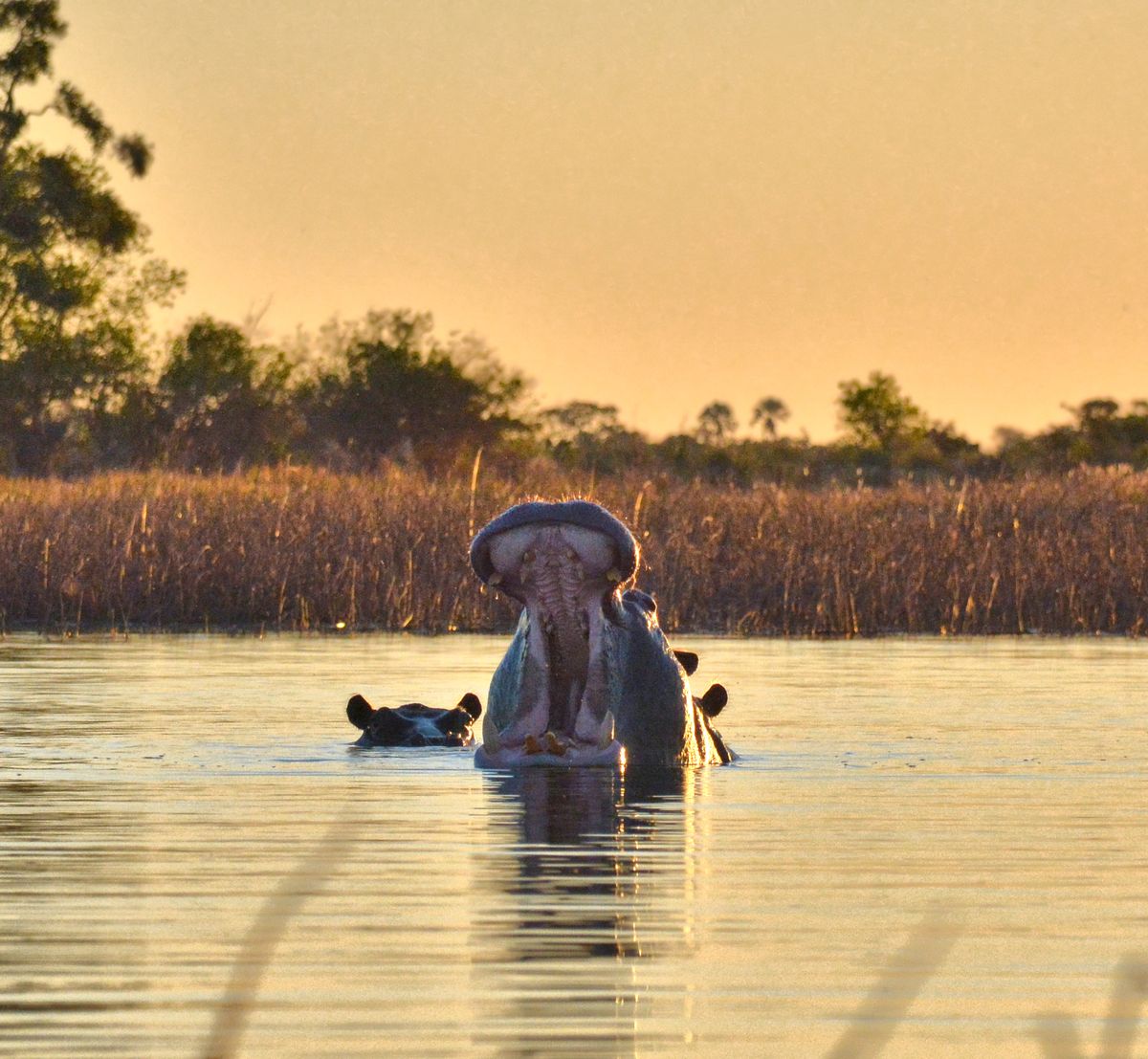
Kagiso had us reversing before the heron finished lifting off, and it was another few seconds before I saw why: two small dark points breaking the surface forty feet ahead, spaced about a dinner plate apart, exactly where the heron had been fishing. Hippo ears, the rest of the animal submerged and the whole business of it invisible until you know a heron's flinch is worth more than your own eyes.
That reversal put us into a wider cut than the one we'd been running, and this is peak flood, June into August, when water that left the Angola highlands months back has pushed the Delta out to nearly three times its dry season footprint. The papyrus stood taller than Kagiso with the pole raised, channels wide enough to punt through what would be reed bed by October.
He'd already warned us at the launch that the run past Xakanaxa lagoon itself was off the table that day, too many hippos crowded into too little water this early in the season for a boat that sits as low as a mokoro does. Guides here pick a route by what a startled two-tonne animal can't reach in three strides, not by what's shortest.
Crocodiles use these same channels, basking along mud banks where the current has cut a bend, and established mokoro routes are chosen to avoid both species' danger zones at once, not just the hippo pods. Kagiso's read of the water covered predators he never needed to point out, because we never got close enough to see them.
spotter's notes
Watch the birds before the water: a heron's flinch clocks a hippo faster than scanning the surface yourself.
June through August is peak flood, the widest and most reliably navigable window for mokoro channels.
Ask your poler which routes are closed that day, not just which are open. A skipped lagoon is information.
Sit still when your poler goes still. He is reading something you have not spotted yet.
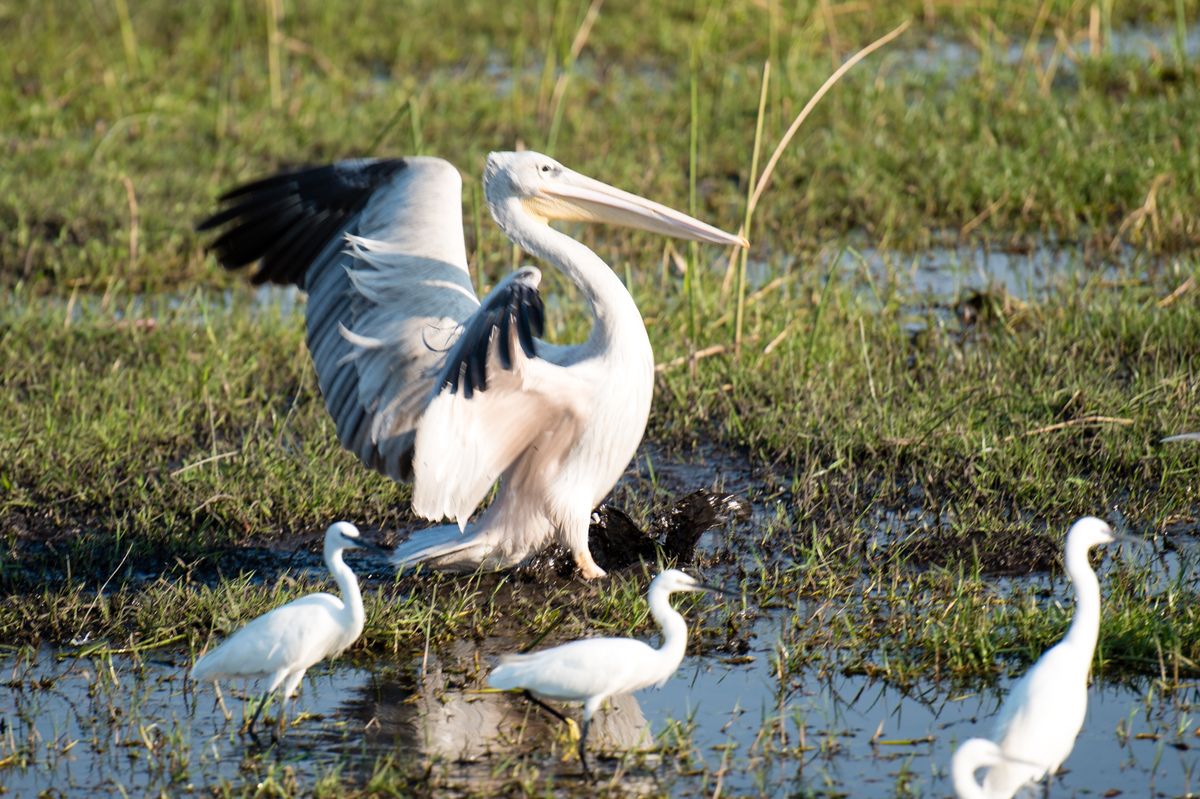
The pelican in the shallows past the reed line didn't so much land as arrive, wings cupping air at the last second while a line of egrets scattered and resettled around it like they'd rehearsed the whole thing. Great white pelicans fish these channels in loose cooperative lines, driving fish into the shallows, and this one had either missed the memo or decided fishing alone suited it better that morning.
Verdict on the morning: no hippo ever fully surfaced, and the closest we came to trouble was a heron doing our poler's job for him before he'd even needed it. The khaki tourist up front got his photo of the ears anyway, camera shutter loud enough that Kagiso didn't bother telling him to keep it down. Some tells you let a man discover for himself. ■