Nosy Be's Forest and Reef, Reached by Paddle and Boat
A day out from Madagascar's Nosy Be that links a mangrove paddle, a rainforest walk and a reef swim with a turtle.

Specimen observed: a man at the village landing who ordered everyone to whisper, loudly, and kept ordering us until the canoe pushed off. Nosy Be is a volcanic island off the northwest coast of Madagascar, and the country's busiest tourist destination. Its name means "big island" in the local language. I come from another part of Madagascar, so I went as a visitor, to see a rainforest and a reef, and the way between them is the odd part: a road, a village, a hand-paddled canoe, then a boat.
Road and paddle
There are no traffic lights on Nosy Be, only roundabouts, and our driver went round each one at the same unhurried speed as everything else on the road. Some call the island Nosy Manitra, the scented island. With the window down I could smell the ylang-ylang farms, where the flowers are grown for their oil.
The road from the main town brings you to Ambatozavavy. That is a fishing village, and the guides and paddlers who take visitors into the forest all come from there. Ours was Mahery, who was already waiting on the landing when we pulled up, and the rim of the canoe beside him was worn smooth in the places where passengers grip.
Our boat was a pirogue, a narrow dugout canoe. Mahery took long, heavy strokes from the back, the paddle going in deep, and each one carried us further than I expected before the pirogue ran on by itself through a channel roofed by mangroves. Under them the air smelled of mud and salt, and drops from the paddle ticked on the hull between strokes.

Field note: Mahery steered between the roots without looking at them once.

Forest floor
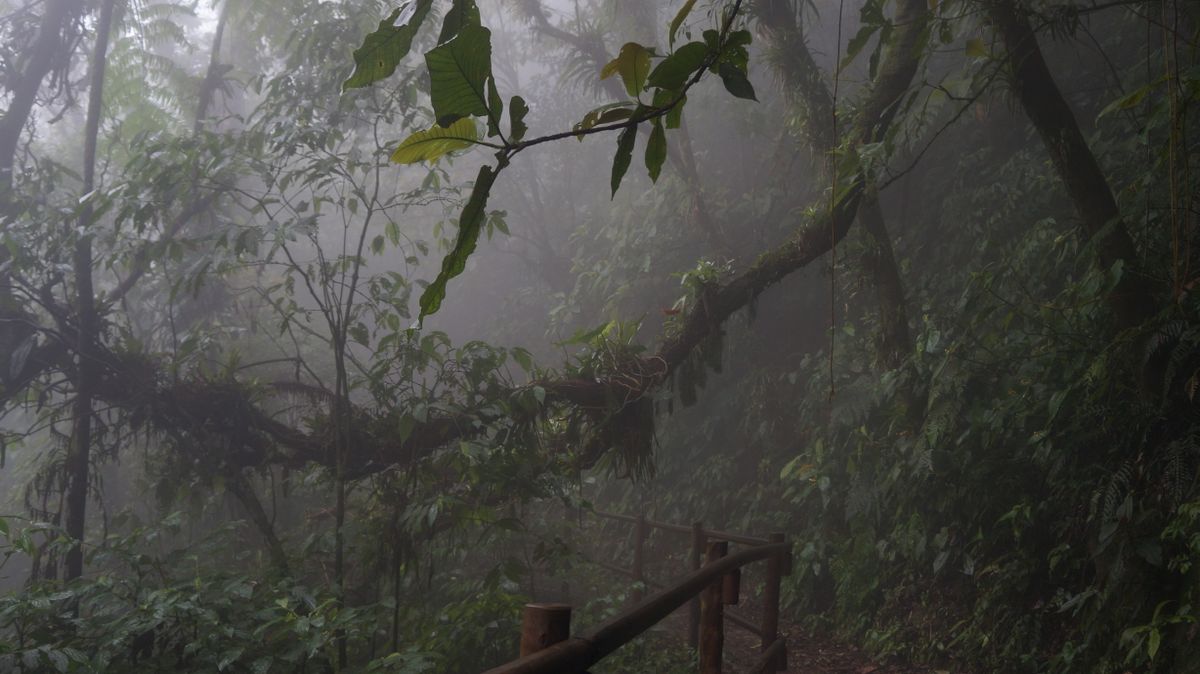
Lokobe National Park lies on the southeastern side of Nosy Be, and it is the last fragment of the island's original lowland rainforest. Mahery stopped us at the edge of it and said, "Step where I step." The ground was a springy carpet of leaves laid down over centuries, which took each footstep and gave back almost none of the sound it should have made. A woman behind me announced herself to the whole canopy anyway, by unzipping her camera bag every few metres.
Mahery pointed up, and there were black lemurs in the canopy, the animals the park is known for. The name is only half right, because the colour splits by sex: males are black or dark chocolate, and females are a lighter brown, chestnut or orange-brown. Females are also the dominant ones in a group, so whenever a chestnut one moved I watched where the dark ones went.
The other animal Lokobe is known for is the Nosy Be panther chameleon, and Mahery found one at the edge of the forest, where I had already walked past it without a glance. Each time it lifted a foot it rocked first, as though the ground were moving instead of the animal, and it kept one eye on Mahery's finger and the other on me for as long as we stood there.
Snorkelling off Tanikely
From the park landing we changed from canoe to motorboat and headed out to Nosy Tanikely, a reef island nicknamed the natural aquarium. The engine made conversation impossible, and by the time Tanikely came up ahead the mangroves were far behind us.
Visibility on the reef often passes 20 metres, which meant I could hang at the surface and follow a turtle without losing it once. Green turtles and hawksbill sea turtles both live around Tanikely, and I never learned which of the two this was, only that it was in no hurry and that it ignored me completely, even when I stopped kicking and drifted over it.

Home past Komba
The boat home went past Nosy Komba, whose name means "island of lemurs". Komba lies 3 km south of Nosy Be and is known for its black lemurs, so I scanned its shoreline for movement in the trees the whole way and saw nothing but leaves. We came ashore on Nosy Be next to an outrigger hauled well above the tide line, the first boat all day built to carry a sail, and I waited by it for the car back to town.
spotter's notes
Lokobe has been an official national park since 2011.
Nosy Tanikely is a 30-minute boat ride from Nosy Be.
Arrive early, or better still stay late, to share the reef with fewer day-trip boats.
It is forbidden to take any animal off Tanikely, chameleons included.