What the Tiles Remember

Alfama, Before the Trams Wake
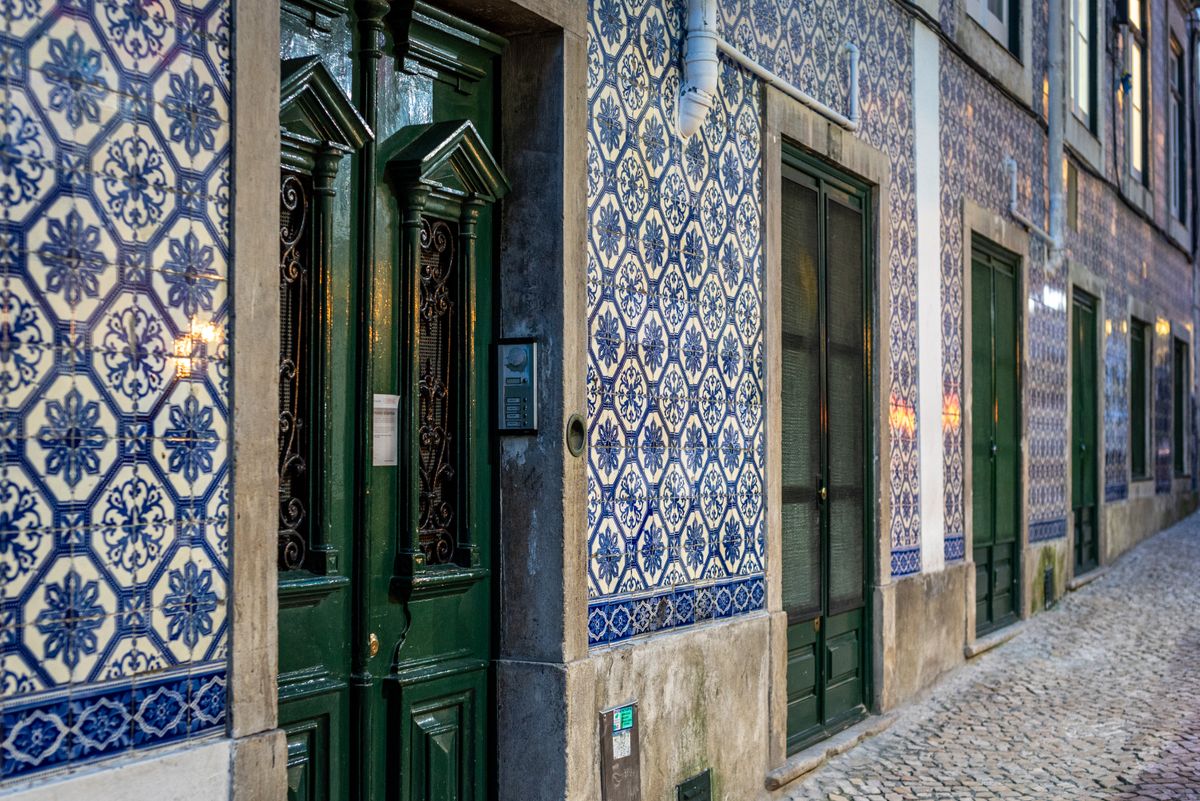
The bakery on Rua de São Pedro opens before the street does, and the smell of it catches me two flights up, warm crust and something faintly burnt underneath, sugar dissolving into stone. It is six in the morning and Alfama's light hasn't decided on a colour yet, it comes in flat and grey off the river and lands against the tiled facades so that for a few minutes every wall in the neighbourhood reads the same pale blue, before the sun clears the rooftops and the blue splits into a hundred separate blues at once, cobalt in one panel, something closer to slate in the next. Then it just holds there, all morning, doing nothing but being looked at.
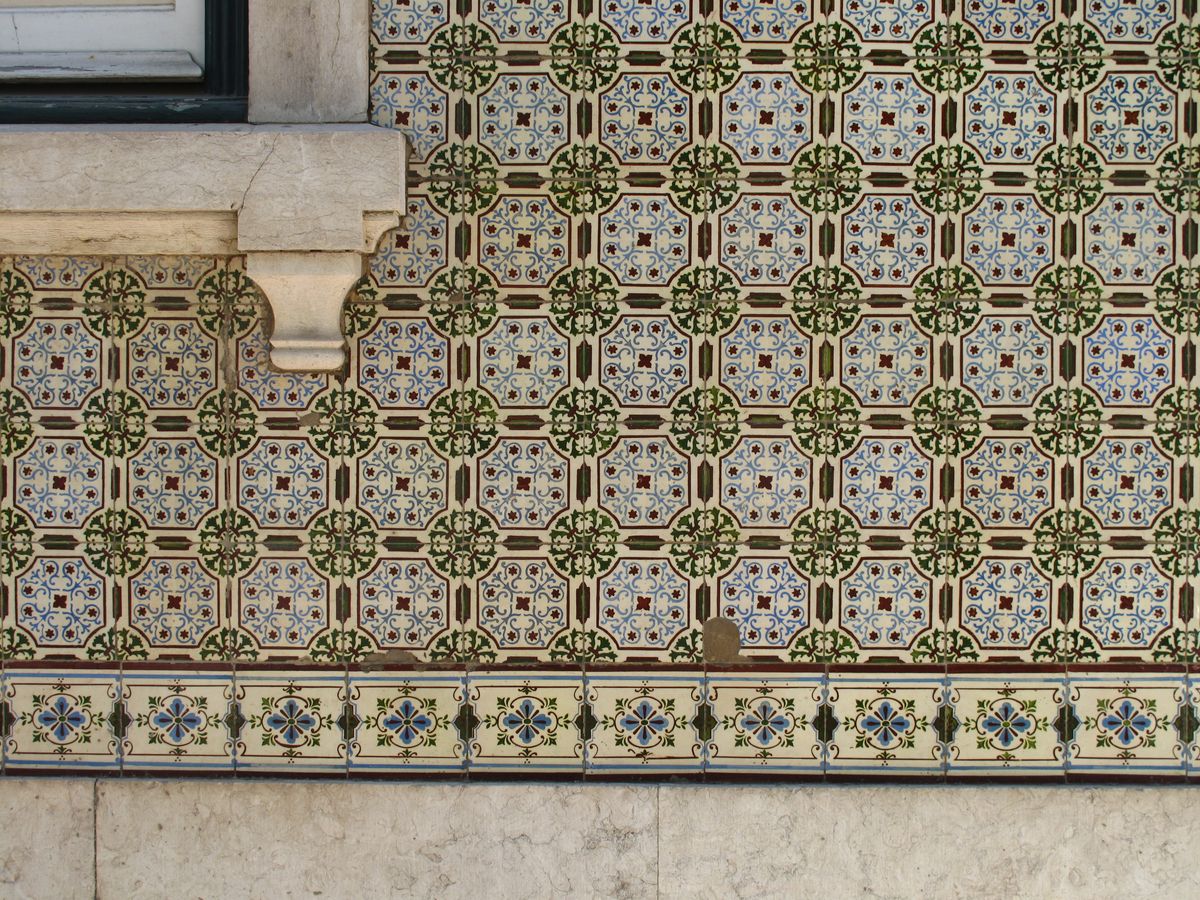
A woman two doors down is already out, wringing a cloth over a bucket, and she leans it against a wall tiled in a pattern of interlocking stars worn soft at the corners from a century of shoulders brushing past. She doesn't glance at the tile, it has been there longer than she has and will be there after, and this might be the only honest way to live next to something beautiful, to stop seeing it as beautiful and start seeing it as load-bearing, the wall that keeps the rain out and holds up her doorway.
The word for these tiles, azulejo, comes from the Arabic az-zulayj, polished stone, a legacy of the Moors who brought glazed ceramic work to the peninsula centuries before anyone in Lisbon was painting blue windmills or blue ships onto clay. Blue-and-white, the pattern most visitors picture, the one on every postcard rack between here and the castle, arrived later still, filtered through Dutch Delftware and the blue porcelain that Chinese traders sent north on ships that once anchored in the Tagus below this exact hill. Alfama wears all of it at once, Moorish geometry next to nineteenth-century floral next to a panel someone restored last spring with tile that hasn't lost its shine yet, and the street doesn't sort the eras for you. It just lets them lean against each other.
By eight the stairs are crowded enough that I lose count of the tiled thresholds I pass, and somewhere past the fourth turn a boy of maybe nine runs his hand along a wall on his way to school, not looking at it, just trailing his fingers over the glaze the way you'd trail a hand along a fence. The tile has gone smooth in a long low stripe from decades of exactly that gesture, other hands, other mornings, doing the same unthinking thing.
Madre de Deus
Inside the convent the temperature drops and the sound drops with it, footsteps on stone flattening into something close to a held breath. The Museu Nacional do Azulejo occupies the old Madre de Deus convent, and the building still remembers being a convent before it remembers being a museum, cool corridors, high windows, a chapel at the far end so gilded it looks lit from within even at midday. A guard near the entrance repositions a velvet rope that a child has tugged loose, not scolding, just quietly restoring the boundary, and moves on before the child's mother even notices it happened.
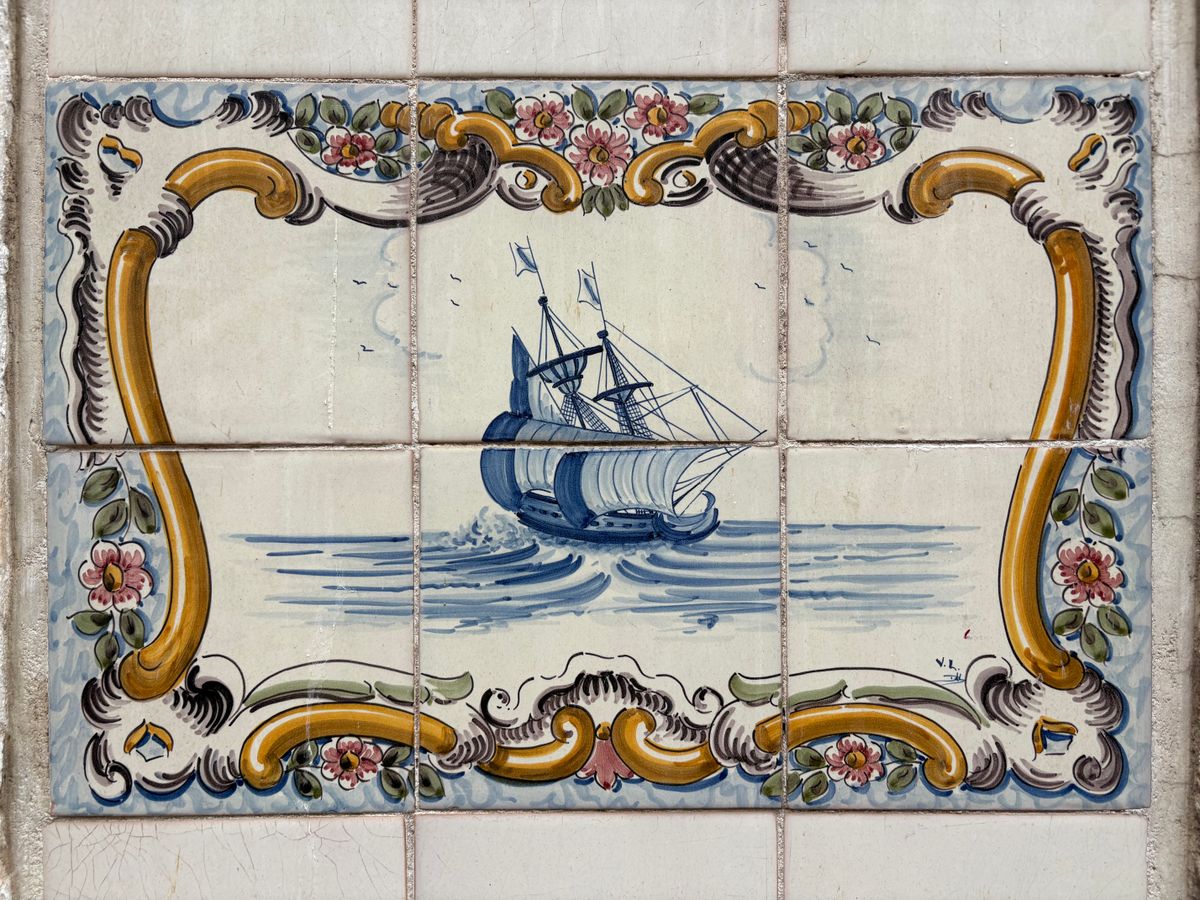
The collection runs room by room through centuries of the same blue and white, tiles that once lined kitchens and church naves and the walls of houses that no longer exist, saved and reset into new frames the way a pressed flower gets saved between glass. One long panel near the cloister shows a ship under full sail, worked entirely in cobalt on white, the kind of maritime scene that turns up again and again in Portuguese tilework because the sea is the story this country keeps choosing to tell about itself.
Standing in front of the ship panel long enough, you start to notice the tiny variations between one hand-painted square and the next, a brushstroke that curves slightly wider here, a glaze that fired half a shade darker there. Evidence of someone no longer anyone's name. Still present, technically, in the room.
Tile is never one hand, it's a hundred hands agreeing on blue.
Baixa-Chiado, After Dark
The metro doors open onto a wash of colour I wasn't ready for, cobalt figures marching across a platform wall in a pattern that has nothing to do with ships or windmills, all sharp modern angles under fluorescent light. Maria Keil designed panels like this one for several of Lisbon's original Metro stations starting in the 1950s, trading the old floral repeats for something bolder, and riding the escalator up out of Baixa-Chiado at night feels like passing through two different centuries of the same idea, azulejo as decoration for the sacred, azulejo as decoration for the daily commute.
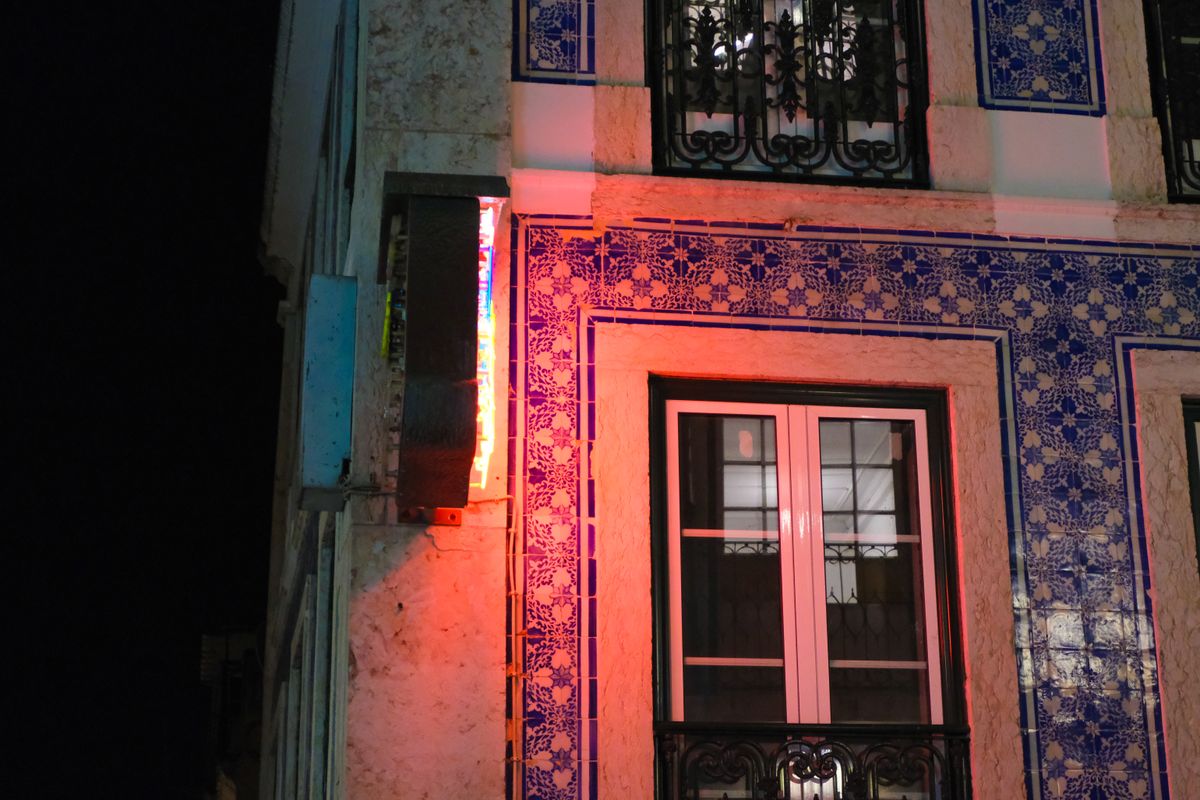
Outside, the tiled facades along the Chiado streets have gone a different colour entirely under the shop lights and streetlamps, that flat morning blue traded for something closer to green-black with a hot white glare where a neon sign catches the glaze at an angle. A young couple stops in front of one particularly ornate building, and the man takes his girlfriend's phone to photograph her against the tile, and takes three tries to get the angle right, tilting, stepping back, checking, tilting again, the kind of small patient fussing that only happens when someone actually wants to get a thing right rather than just get it done.
I think about the woman wringing her cloth this morning, load-bearing beauty, and about the guard's quiet rope, and about the boy's hand trailing smooth stone, and none of it adds up to a lesson exactly. Lisbon just keeps handing you the same tile in a different light and letting you decide what it means this time. ■