Borobudur at Sunrise, Before the Mist Lifts
Watching first light reach Borobudur, the Buddhist temple in Central Java, while the mist slowly clears from the forest below it.

An hour before the sun clears the mist, the hillside smells of wet leaves and cold smoke, and the only sound is water dripping off the trees, so that the first bird, when it comes, seems very loud.
Below me in the dark is Borobudur, a Buddhist temple in Central Java, Indonesia, built in the 9th century. I cannot see it yet, only the place where the black of the trees stops and something flatter and heavier begins.
Then the gold comes in, low and sideways, and the mist lights up from underneath with the temple a small dark shape in the middle of it. It stands on the Kedu Plain, which is sacred in Javanese belief and is known as the garden of Java for its fertility. The temple sits between twin volcanoes, and all I can make of them from here is a pair of faint shapes on the horizon.

The climb in first light
The gold has faded by the time I reach the temple, and the light that replaces it is soft and even, the pale grey of a sky with thin cloud in it, so that the stone walls and the mist in the valley look almost the same colour.
At the top of a flight of steps I turn round in the gateway and look back down the way I came, out over the trees. A woman stops beside me between the two stone lions, settles the bamboo slipper that visitors are expected to wear back onto her heel, and looks out at the mist for as long as I do. Neither of us says anything, and when she goes on up, I follow a few steps behind her.
Worship at Borobudur is a walking pilgrimage up through stairways and corridors to the top platform, with 1,460 narrative relief panels along the walls and balustrades to guide the way, and each platform stands for a stage of enlightenment. Pilgrims circle each level clockwise as they rise, a practice called pradakshina.
Stupas in the sun
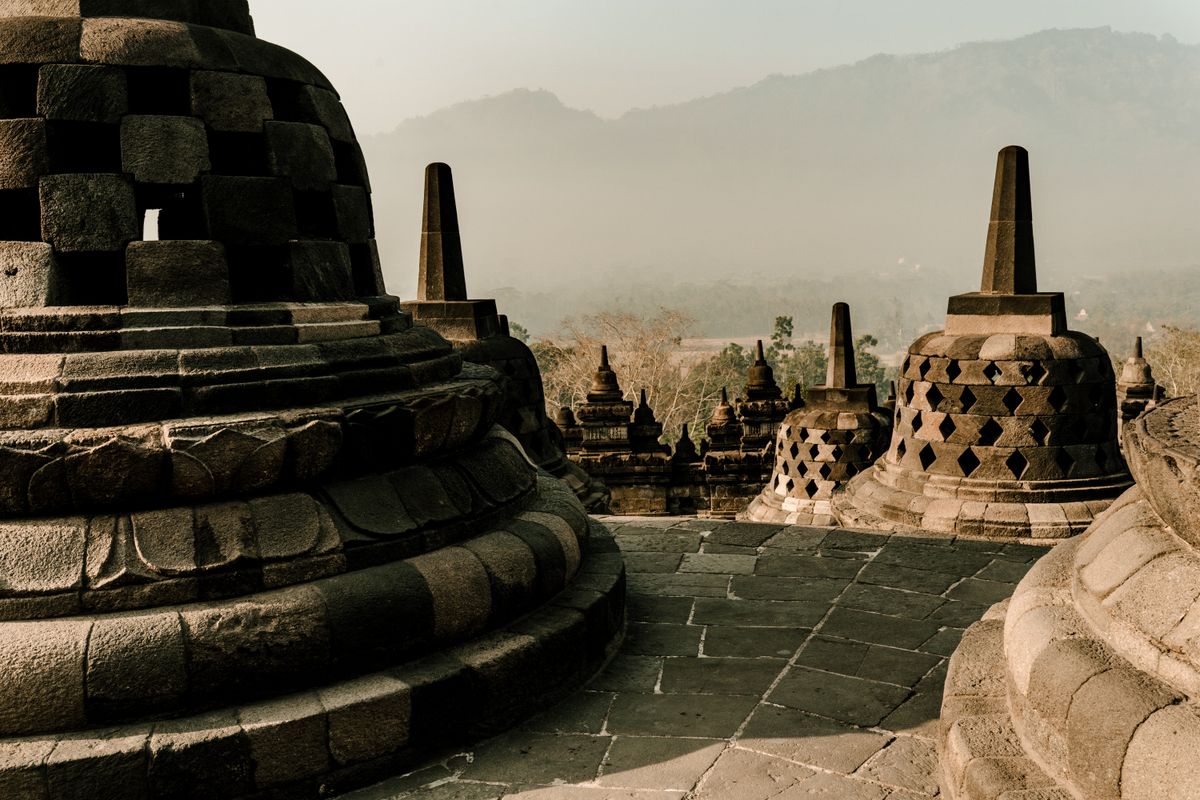
Stupas on a round terrace.
The cloud is patchy this morning, and as I step up onto the first round terrace a gap opens in it, so that warm light falls across the paving and the stone goes from grey to the colour of weak tea. Borobudur is nine stacked platforms, six square and three circular, under a central dome.
On the three round platforms stand stupas, which are bell-shaped stone shrines. Around the central dome sit 72 Buddha statues, each inside its own stupa behind a stone lattice. Nobody used mortar to build any of it: the blocks were laid dry, with knobs, indentations and dovetails cut into them to lock each one to the next.
For a minute the only thing moving is the mist in the forest below.
Where the mist thins
The gap closes again by the time I reach the top, and the cloud settles grey and white and low, with the sun only a thin pale glow along the horizon, so the forest below gives up its mist slowly, one strip at a time, and the green comes through.
Notes for the morning
Borobudur is about 40 km northwest of the city of Yogyakarta.
Mendut is about 3 km east of Borobudur, and Pawon sits between them, 1.15 km from Mendut and 1.75 km from Borobudur.
Look for the 100 spouts at the corners that carry off stormwater; each has its own carved gargoyle.
The temple is decorated with 2,672 relief panels in all, so leave time for the galleries.
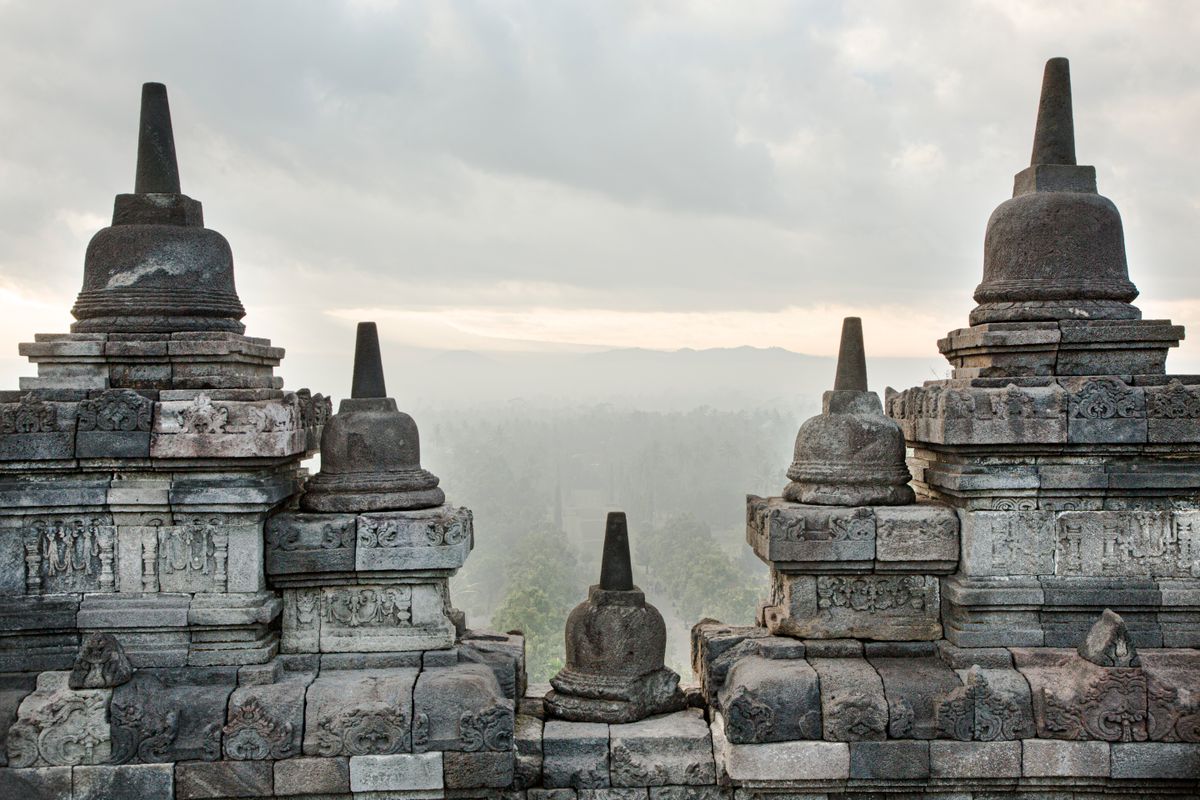
Borobudur lay hidden for centuries under layers of volcanic ash and jungle growth, and when the major restoration began in 1975, over one million stones were dismantled, catalogued, cleaned and treated, like the pieces of a jigsaw puzzle. UNESCO listed it as a World Heritage Site in 1991, after the work was done.
Two other Buddhist temples, Pawon and Mendut, lie with Borobudur on a straight line from east to west. At Vesak, the Buddhist holiday in May or June, the ceremony is centred on a walk from Mendut to Pawon that ends at Borobudur. I have not walked it, and mean to, another day. One researcher has proposed a pilgrimage in the opposite direction that follows the sun's path, with Borobudur as sunset, Pawon as the zenith and Mendut as sunrise, though no written records survive to say how the ritual went.
I go down by the northern stairs, which have had wooden covers since November 2014 because about half of the temple's stair surfaces are badly worn, and the boards knock hollow under my feet while the last of the mist lifts off the trees. ■