The Three Tempers of La Boqueria
A Greek beekeeper walks Barcelona's Mercat de Sant Josep at three different hours and reads three different hive tempers in the same room.

Orientation Flights
The market was calm at twenty to eight, the kind of calm I trust and don't get much anymore in my own apiary, where June robbing pressure puts a short temper on even a docile hive. No pushing at the entrance boards, no raised voices, no jostling for space at a doorway too narrow for the traffic it will carry by noon. Whatever La Boqueria becomes after nine, it starts the day like a hive on its first orientation flights: a few workers testing the air, everyone else still inside.
I came in off La Rambla through the wrought iron arch, past a market that has been trading on this spot since the 13th century, when stalls stood outside the old city gate and sold whatever wasn't allowed past the wall. The building over my head is newer than the trade: an arcaded iron and glass hall raised in the 1840s, after a fire took the Convent of Sant Josep in 1835 and left the ground free. Officially it is still Mercat de Sant Josep. Everyone calls it La Boqueria, which is either the market or the name of a much older butcher's guild, depending which stallholder you ask and how much time they have.
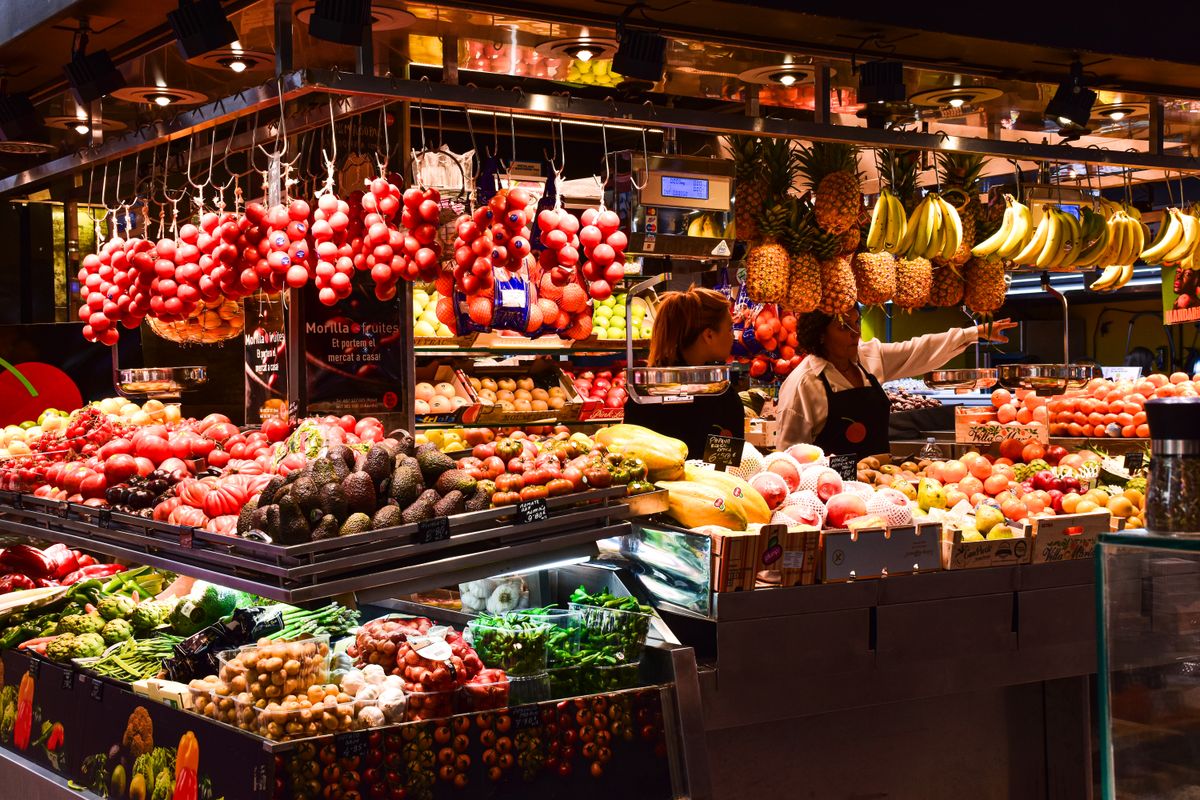
At a fruit stand three rows in, a woman was building a pyramid of figs one at a time, turning each one so the split side faced away from the aisle. She wasn't performing for anyone. There was nobody there to perform for yet, just two men in market aprons wheeling a hand truck of crates past her, and an old man buying a single net of oranges who she clearly already knew by his order. That is a hive at first light: workers moving with purpose and no display, because display is for when there's an audience worth defending against.
Behind her, a fishmonger was still icing his slab, shovelling crushed ice from a bucket in even strokes before he'd set out a single sardine. Nobody was watching him do it, and he wasn't performing efficiency, he just knew how much ice a case needs and measured it out, no more, no less.
If this were my apiary I'd call it a good morning to work without the veil. Nothing here is guarding anything yet. Whatever La Boqueria turns into by lunch, it isn't lying about what it is right now, and the difference between the two states isn't temperament changing, it's traffic changing. I'd log it and move on before the day proved me wrong.
Peak Bloom
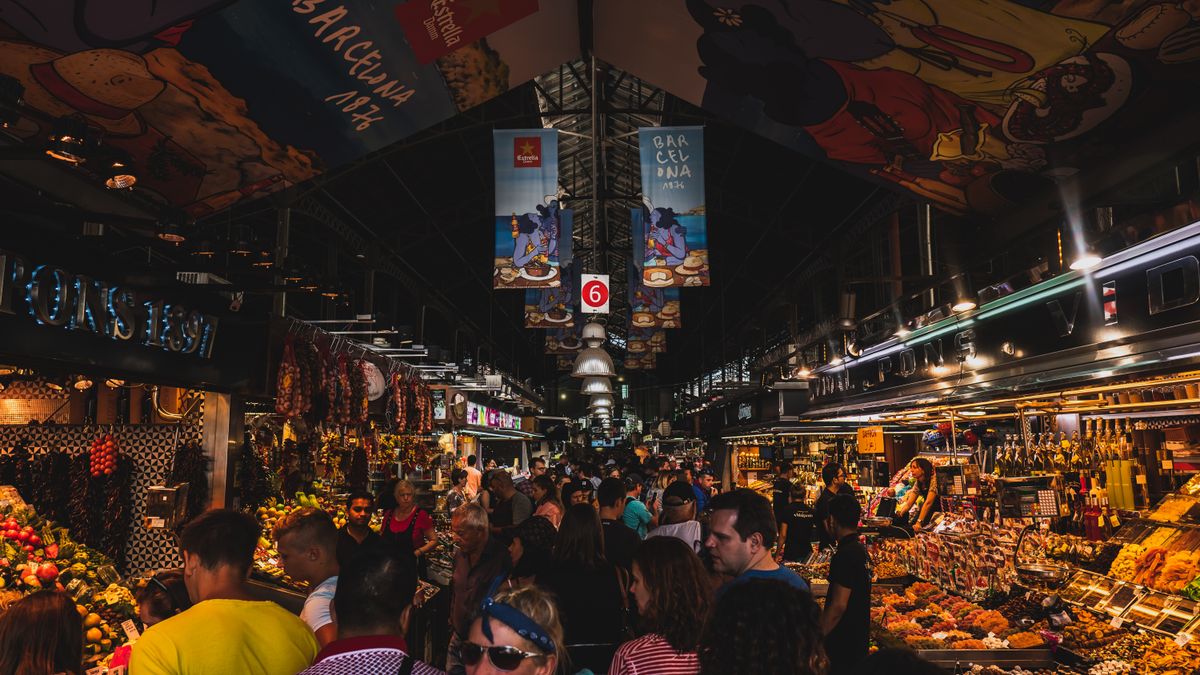
Aisle traffic at midday, a numbered section sign holding its place overhead.
By eleven the market had gone from a hive on orientation flights to something closer to peak bloom traffic: every forager out, every entrance loaded, comb filling faster than anyone can cap it. That isn't chaos. Peak bloom looks frantic to someone who's never kept bees, and it is, in its way, the most organized a hive ever gets, because every worker has exactly one job and exactly one flightpath and no patience for anything blocking it.
La Boqueria runs more than 300 stalls under that iron roof: produce, whole fish laid out on ice like they're still deciding whether to move, cured meat, sweets stacked in cellophane cones, and butchers with rabbits and pigeons hung by the feet the way we'd never get away with at home. Every aisle has a number hanging from the rafters, which I appreciated the way I appreciate frame numbers scratched into a super: not romantic, but it means nobody has to guess where they are when it gets loud.
The iron and glass roof does what any roof does at midday in August: traps heat, holds noise, and turns every competing radio and shouted order into a single pressure I could feel in my ears before I could pick a single sound out of it. That's not the market failing at ventilation, that's peak bloom: more traffic than the architecture was built to carry gracefully.
The city put a rule on this crowding in 2015: no tour group over 15 people through the doors on Fridays or Saturdays between eight and three, which is the market's own peak bloom window. It wasn't City Hall's idea originally. The stallholders asked for it, the way a beekeeper asks a neighbor to move an apiary that's pulling too hard on a shared forage radius. Security stands at the entrance and counts, and a group that comes in over the limit gets turned back at the door, guide and all.
I watched it happen once, a guide with a raised umbrella and a clump of twenty-some behind her, stopped and split at the arch while security counted heads like a beekeeper counting frames for brood pattern. Nobody in that group was behaving badly. They were behaving like a hive with a queue backed up at an entrance built for a tenth the traffic trying to pass through it at once, which reads as swarming to an untrained eye and is actually just a bottleneck with no venting. Six people peeled off toward the Rambla to wait. The rest filed through, and the tension went with the ones who left, because the tension was never a mood, it was a doorway.
Swarming has a cause every time, and it's never the bees being unreasonable. It's a box that got too full too fast. What I'd do about a hive like this one is what Barcelona already did: don't punish the traffic, size the entrance to it, or split the load before it backs up. The 15-person cap is a hive body added at the right moment. It doesn't fix the crowd, it just gives it somewhere to go instead of piling at one board.
Swarming isn't bad manners, it's a box that filled faster than the entrance could vent it.
— smoker notes
The Late Frame
By half past one the market had eased into what I think of as the late frame: not the busiest pull of the day, but the richest one, when what's left in the comb is the good stuff and there's finally room to look at it properly. The crowd had thinned by maybe a third, and the ones still there weren't passing through anymore. They'd found where they were going and sat down.
Outside on La Rambla the street performers had finally set up, three of them in a row painted gold and bronze and holding poses for coins, which told me as much about the hour as any clock. They don't work mornings. There's no traffic in it for them before the market crowd spills back out onto the street with lunch still on its breath.
That's where I found El Quim de la Boqueria, a counter bar a few rows in from the Rambla side, stools three deep and a griddle going the whole time I watched it. El Quim is known for its fried eggs, for ham croquettes, and for squid done simply enough that you can tell in one bite whether the kitchen respects the ingredient or is hiding behind the frying oil. It doesn't hide.
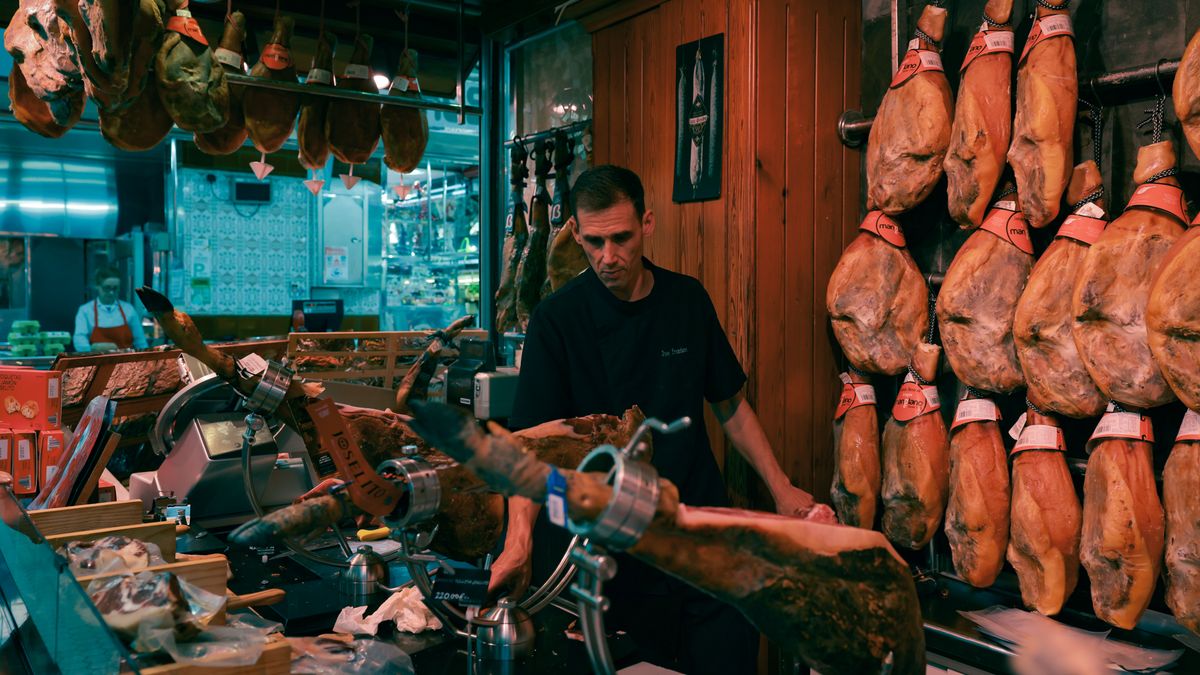
Two stalls down, a butcher was slicing jamon off a leg clamped into a wooden jamonero, taking each slice thin enough to see the counter light through it before it folded onto the paper. Whole legs hung above him in a row, trotters up, the fat rendered gold where the light hit it. He worked without watching his hands, the way I check a frame for eggs without needing to find my glasses first: you know the material well enough that your eyes are free to do something else, which for him was keeping half an eye on who was next in line.
hive notes
Arrive before eight for the calm read: quieter aisles, vendors still setting up, no queue at the entrance.
Traveling with a group larger than 15? Skip Friday or Saturday between 8am and 3pm, when the cap turns oversized tour groups away at the door.
El Quim de la Boqueria and El Pinotxo are counter service only, no reservations. Go hungry and be ready to stand.
Aisles are numbered on hanging signage, useful for picking a meeting point in a market running more than 300 stalls.
I ate a fried egg over ham croquettes at the counter, standing, because there was nowhere to sit and nobody minded standing. The egg had that dark, crisped lace edge you only get from proper heat and enough oil, and the croquette underneath went from crust to cream in one bite with no in-between texture pretending to be there. Nearby, El Pinotxo, the other counter everyone mentions, sits right inside the main entrance on the right, and does the same job for a different crowd. I didn't need to compare them to know both were built the same way honest work usually is: for the people standing there, not for the ones taking a photo of it.
My verdict on La Boqueria, for what a beekeeper's verdict is worth: it is not one hive but three, depending what hour you walk in, and none of the three is lying to you about what it is. Morning is orientation flights. Midday is peak bloom, honest work under real pressure, with a queue problem the city actually fixed instead of just naming. Afternoon is the late frame, the part worth waiting for. I'd tell anyone keeping a hive or running a market stall the same thing: don't judge the temperament by the one hour you happened to open the lid. ■