Wait for the Water: A Day Through Andalusia's White Towns
Zahara de la Sierra, Setenil de las Bodegas and Ronda, three white towns in Andalusia, taken in by ear as much as by eye.

Zahara de la Sierra: the first bell
A shutter bangs open somewhere above the lane, a motorbike coughs once and gives up, and then a church bell takes a few uneven swings. That is how Zahara de la Sierra, a white town in Andalusia in southern Spain, arrived: in my ears before my eyes. White towns are whitewashed towns in the northern parts of Cádiz and Málaga provinces, and Zahara counts as one because the overwhelming majority of its buildings are white.
The remains of the Moorish castle still exist, long after Castilian troops captured the town in 1483, and I kept glancing up at the crag to find them. Zahara is perched on a mountain, looking down on a valley and a man-made lake, and the lake was formed by a dam that must be driven over to reach the town.
On a steep lane a woman pushing a bicycle stopped so the bell could finish its count, and I stopped with her. The strokes came slowly, each one handed out over the roofs before the next began. Whitewash is old in these towns: it was introduced in Roman times, and during the plague waves of the 14th century and after, people whitewashed interior walls as well as exteriors.


Setenil de las Bodegas: under the rock
Setenil de las Bodegas is a small town in Cádiz province, famous for dwellings built into a rock formation. Some parts of the town use the rock as walls and roof of the houses, so I walked the lanes with my head tipped back, checking what was house and what was cliff.
The bodegas in the town's name are wineries. They were wiped out by the phylloxera insect infestation of the 1860s, though olives and almonds still flourish in the district. Setenil grew from a fortified Moorish town on a bluff above a sharp bend in the Río Trejo, and Christian forces finally took it in 1484, after an earlier attempt in 1407 had failed.
I would give the acoustics under the overhang a kind review: warm and a little close, like a back room where nothing leaks out to the street. A radio in a kitchen doorway was playing a slow flamenco guitar, low enough that it seemed to belong to the rock. Further along, a man at another door swept his step in long unhurried strokes, and the broom was the only other sound on that stretch.
Ronda: the gorge
Ronda is a town in Andalusia on a plateau about 600 to 800 metres above sea level, and a deep gorge called the Tajo splits it in two. The arched stone bridge across the gorge is the Puente Nuevo, the new bridge, which stands 120 metres above the gorge floor and is the tallest of Ronda's three bridges.
Set list notes
Ronda's White Towns route also includes Olvera and Grazalema, two more white towns, if you want to stretch the day beyond these three.
Most of the white towns lie within the Sierra de Grazalema Natural Park, the highest rainfall area in Spain, so check the forecast before you set out.
The Garganta Verde canyon is near Zahara, if you want a longer stop there.
A horn answered a church bell from the far side of the gorge.
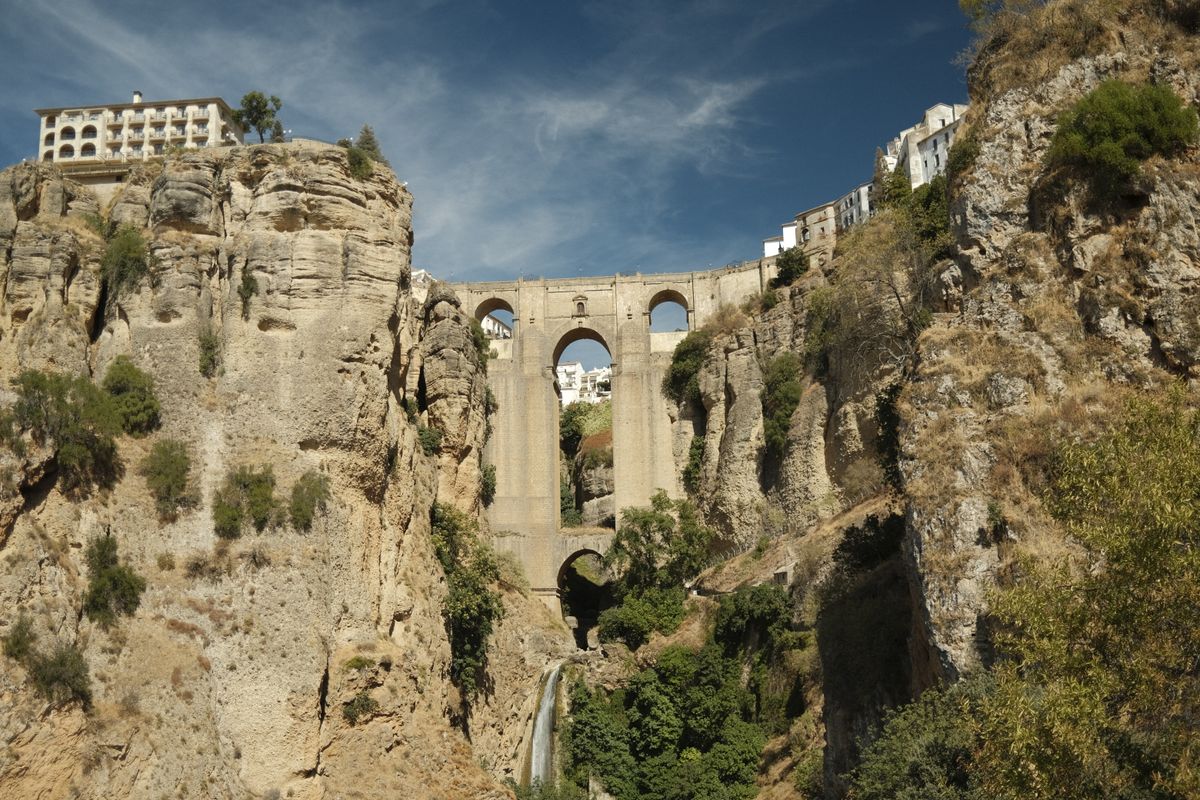
The name is something of a misnomer, because work on the bridge began in 1751 and took until 1793, so the new bridge spent a long stretch of the eighteenth century as a building site. I stood on it a while. The Guadalevín, the river far below that carved the gorge, makes a low hiss that reaches the bridge late and from every side at once, and a man beside me lifted a finger and said, "Wait for it." We waited. A moped crossed behind us and beat the hiss, and then the hiss came back. From the far side of the gorge a horn answered a church bell, and neither let the other finish.
I stayed on the bridge until the moped and the horn were both gone, and the hiss settled into one long note. ■