Santorini's Caldera Rim in the Off-Season
Along the caldera rim from Fira to Oia, Santorini in early October had room on the cable car, in the lanes and on the terraces.

The island was calm the morning we arrived, the way a hive is calm when the guards have stood down and the entrance board is only wood in the sun. Santorini is a Greek island in the southern Aegean, about 200 km southeast of the mainland, and people come for its caldera. That is the sunken bowl of the old volcano, and from the rim that morning it was a long bay of flat water under a haze so thick that the far wall barely showed.
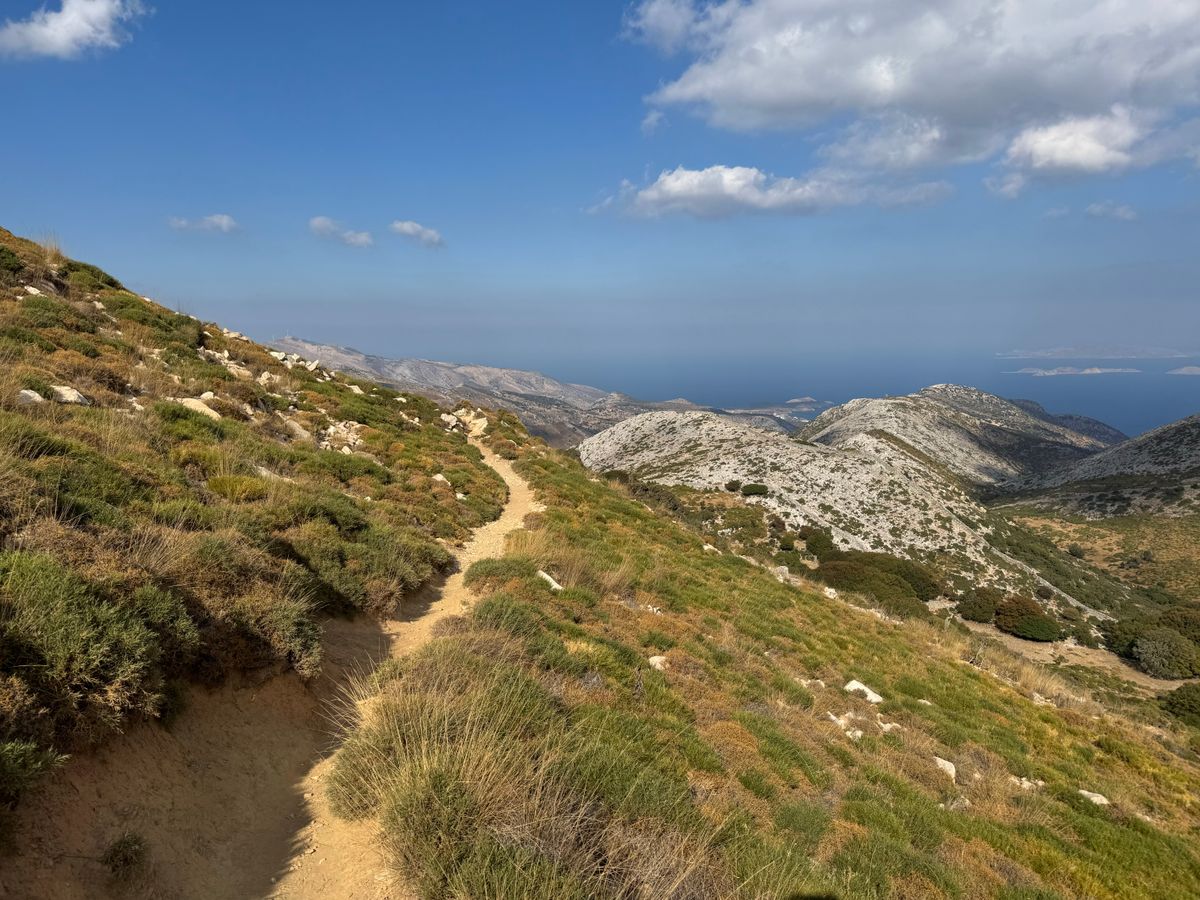
At its highest point the caldera's inner wall drops more than 300 m, and the old lava shows in it as layers of brown and rust, one on top of another, with the main towns sitting along the crest. My sister and I had a few days in the first week of October to walk along that crest. We started in Fira, the island's capital, and on the first slope I could see a thin track slanting down toward the water, and I never did settle whether it was a path or a line the weather had drawn.

Fira and the cable car
Fira sits right on the edge of the caldera, with a view down the whole 18 km of it and Nea Kameni, the volcanic island at its centre, out in the water. Cruise ships anchor off Skala, the old port below the town, and their passengers come up to Fira by cable car, on foot or on donkeys.
By the second morning the haze had gone and the sun was hard. A man waiting at the top station watched the cars come up and said, to nobody in particular, "Every year I promise I will walk it, and every year I am in the box." We walked it, down the zigzag footpath the donkeys also use, and on the upper bends the cars passed at eye level, close enough to make out who was riding in them.
The lower terminal by the port had no queue at all, so we rode straight back up, and I read that empty platform the way I read a hive entrance on a good day: nothing bunched at the door, and traffic moving in and out at the pace the door allows.
Oia, off the main street

A quiet corner off the main street, with a carved wooden door and a weathered blue one.
We walked into Oia, at the northwest tip of the island, on our third day, and the first person we passed was a man hosing down his own doorstep with nobody else in sight. The village had 1,087 inhabitants at the 2021 census, a small number to set against the estimated 2 million tourists who visit Santorini each year. Its money came from a merchant fleet trading in the Eastern Mediterranean, at its height in the late nineteenth and early twentieth centuries, and the two-storey captains' houses on the highest part of the village are a reminder of it.
Houses on the island use hypóskapha, rooms dug sideways or down into the pumice, and these stay cool in summer and warm in winter. So the weathered blue door in a rough wall, at the first quiet corner we found off the main street, could open onto more house than its front shows. The only sounds were a shutter somewhere above us and my sister's shoes on the stone.
Coffee under a flowering vine
On the way out of Oia we stopped for coffee at a terrace where nobody else was sitting and a radio played low somewhere inside. My sister took the cushioned bench, put her hat over her face and was asleep within ten minutes, so I went in, ordered at the counter and carried the coffees out myself. She slept for over an hour, which I spent looking back across the village toward the blue dome, trying to work out which of the higher houses had been the captains'.
hive notes
Ferries run between Santorini and Piraeus, the port of Athens, every day of the year, with up to five direct crossings in summer.
Between Fira and Skala, the old port, you can ride the steep cable car or take the zigzag footpath, on foot or by donkey.
In Oia the main street is Nikolaou Nomikou, and the captains' houses are on the highest part of the village, so plan to walk uphill.
Assyrtiko is the island's own grape, the one to look for on a wine list.
Summers are dry and winters relatively wetter, so a rain jacket is worth packing for a winter trip.
Smoker notes: an hour on that bench, my sister asleep, every other table empty.

Santorini's vines are planted far apart because their main source of moisture is dew, which matters on an island with about 270 mm of rain a year, and they are often trained into low spiralling baskets with the grapes hanging inside, out of the wind. The wine is based on Assyrtiko, the island's native grape, and growers get only 10 to 20% of the yield per hectare that is common in France or California. ■