A Street-Cook's Verdict on the Road to Merzouga: Tagines, Tea, and the Sahara Gateway
A street-food cook drives Fez to Merzouga rating harira, tagine, and the desert camp's mint tea along the way.

Fez to the Ziz Valley, Nose First
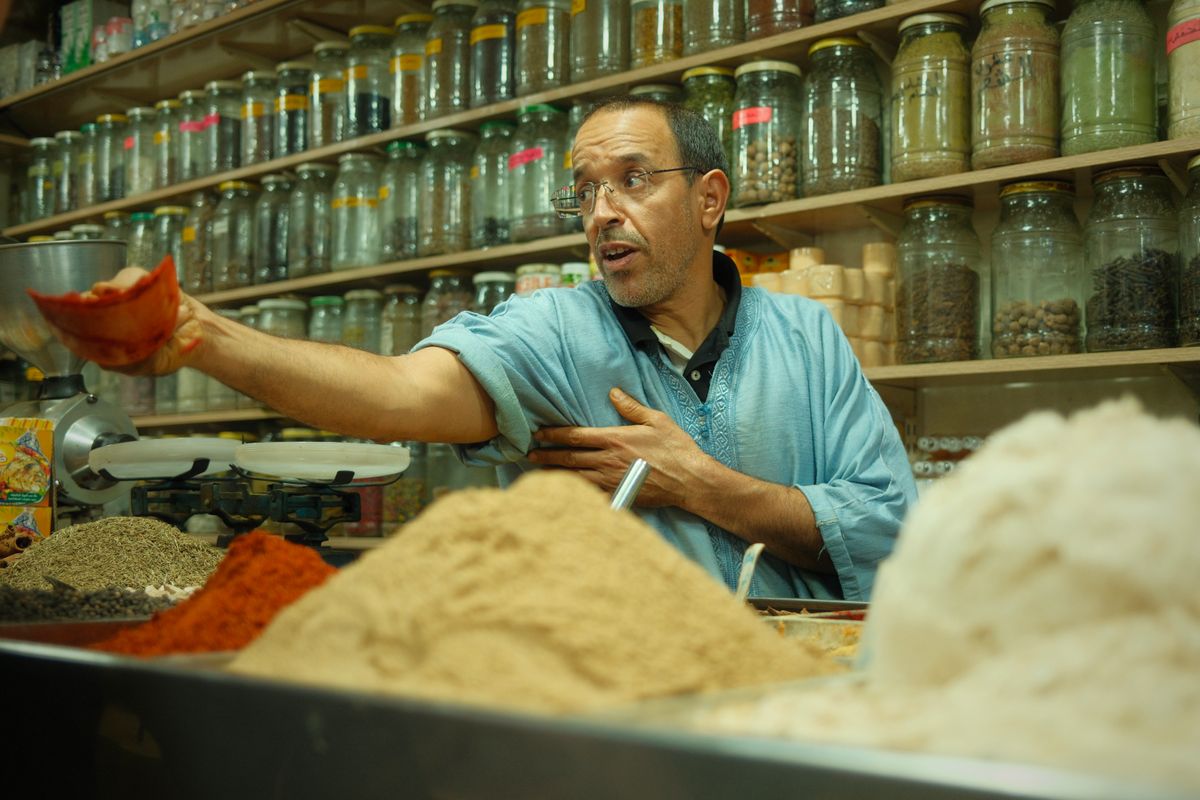
Ras el hanout means "top of the shop" — no two vendors mix it the same.
The bus out of Fez still smelled like diesel and someone's cold sandwich when I caught the first real smell of the trip: cumin, toasted, coming off a stall we passed near Ifrane before the road even started climbing. I know a spice being cooked into oil from a spice just sitting in a bag, and this was the cooked kind, someone frying it to wake it up before the lunch rush. Good instinct. I do the same with my own five-spice, thirty seconds in hot oil before the pot goes on, or it stays asleep the whole simmer.
By the time we crossed the Middle Atlas the smell changed to woodsmoke and cedar, and by Midelt it was diesel again, then roasted almonds from a roadside cart, then nothing but hot rock and the driver's cigarette for two hours through the Ziz valley, palm trees stacked so thick along the riverbed you'd think somebody planted them in rows on purpose, which somebody did, a few hundred years ago.
We stopped in Er-Rachidia for the toilets and I ended up in a spice stall for twenty minutes, which is longer than any toilet break should take. The man running it had maybe fifteen open sacks, saffron threads locked behind glass the way saffron always is, cumin in a mountain you could put your whole forearm into, and a blend he called ras el hanout that he mixed to order, a scoop from this sack, a scoop from that one, nothing written down. Ras el hanout means 'top of the shop,' the best a seller's got, and every stall's version is different because there's no fixed recipe, just a vendor's opinion of what belongs together. My own five-spice is four ingredients and hasn't changed in eleven years. His had at least twelve and changed a little every time I watched him spoon it.
The harira came at a roadside stop past Errachidia, in a bowl too hot to hold with bare hands, which is how you know it's fresh off the flame and not reheated for tourists. Lentils, chickpeas, small cubes of lamb, tomato broken down soft, celery, a fistful of coriander stirred in at the very end so it stays green instead of going that boiled-grey it does if you add it too early. The broth had body to it, not from cream or flour dumped in raw but from tedouira, a thin paste of flour and water whisked into the pot in the last few minutes, the same trick I use to thicken my own broths when I don't want the starchy taste of cornstarch coming through. Whoever made this one knew to add it slow and keep stirring or it clumps.
No spoon came with it. You get khobz, round and flat, baked that morning in a communal oven judging by how the underside was scorched in patches rather than evenly browned like an electric oven does. You tear it, fold it, and use the folded edge to scoop, which does double duty as a utensil and a second course once the bowl's empty and there's broth left to mop. I'd have reached for a spoon for speed during a lunch rush, but for a soup this thick, the bread's actually the better tool, less waste at the bottom of the bowl than a spoon leaves. Seven out of ten, and I'd tell a customer to order it hot or don't bother.
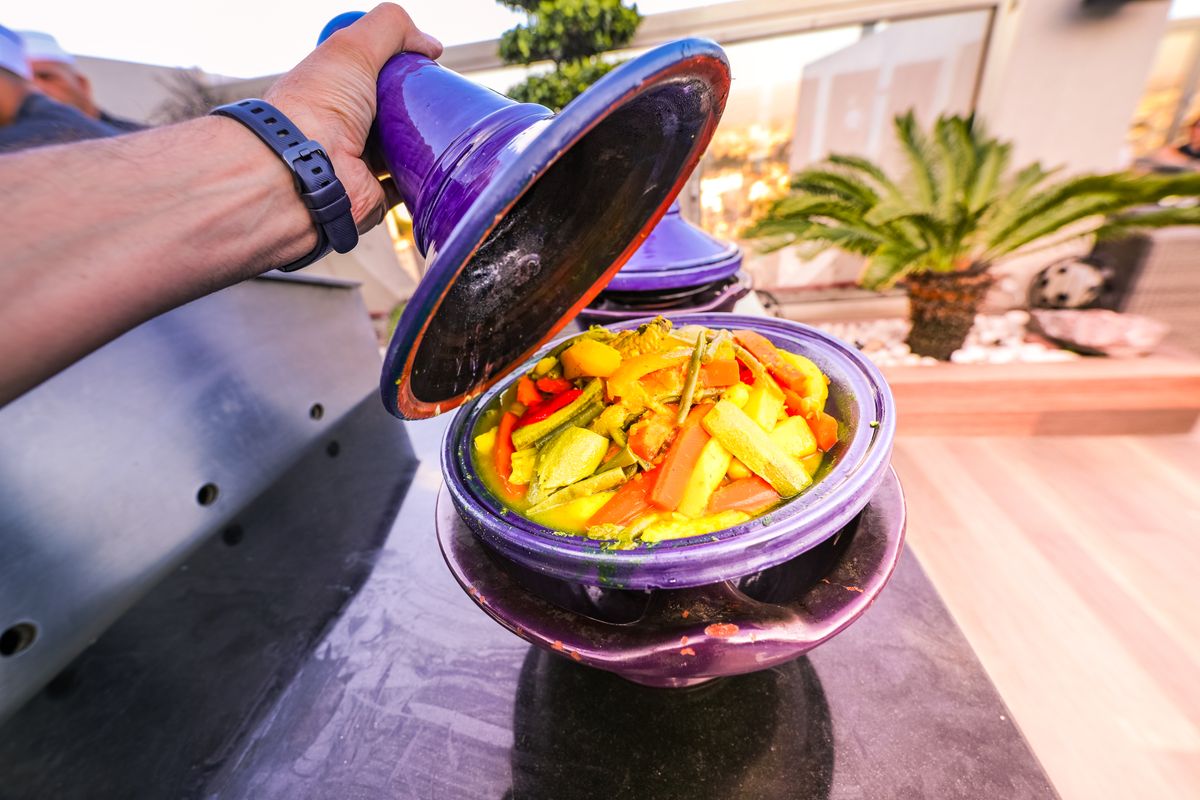
A Tagine Earns Its Lid in Merzouga
The lid came off before the smell reached us, in a kitchen tent at the edge of Merzouga with a cook who'd clearly been at those coals since mid-afternoon. Steam first, then underneath it something sour-sweet, preserved lemon, and beneath that the flat, mineral smell of saffron that's been sitting in liquid a long time rather than just dusted on top at the end. Whoever seasons a tagine at the start and lets it ride the whole cook, not one of these last-minute saffron sprinklers.
Under the lid it was lamb on the bottom, close to the heat, then a layer of carrots and quince cut into batons, then olives and preserved lemon quartered on top, barely touching the liquid. Nothing had been stirred, you could tell by how clean the layers still looked, like a cross-section rather than a stew that's been agitated for two hours.
The whole method is the cone. Heat sits low and steady, coals or a small gas ring under a wide shallow base, and the tall clay lid traps the steam rising off the meat and sends it back down the sloped sides as condensation, basting everything above without a hand ever touching a spoon. It's a slow-cook with no stirring, which sounds lazy until you understand it's the opposite, the whole dish is engineered so stirring would ruin it, since the vegetables on top are meant to steam gently rather than boil in the juices, and stirring would push them under and turn them to mush. I braise in a wide flat pot over open flame with the lid half off so I can watch and adjust, which means I'm babysitting it the whole service. This thing cooks itself for two hours while the cook goes and does something else. I'm a little jealous of that, honestly.
The lemon and olives only went in near the end, which is the right call. Put preserved lemon in from the start of a two-hour braise and the rind turns bitter and the flesh disintegrates into mush instead of holding its shape. The lamb had gone properly soft, pulling off in strands with barely a nudge from the fork, but the carrots still had bite to them, structure intact, which told me whoever built this knew exactly how long each layer needed and packed it in reverse order of how fast it cooks.
Nine out of ten, and if I ever get a tagine pot for the cart, I'm not telling my regulars how much easier my afternoons just got.
Mine needs watching; theirs cooks itself under a lid I'm not allowed to touch.
Mint Tea Under the Dunes
Tea in the desert camp started with a smell I know from home even though the leaves were different, hot metal off the pot itself, then green tea, sharp and slightly bitter, then mint crushed rather than just steeped, you could smell the bruising on it before the water even touched the leaves.
The boy pouring it rinsed the gunpowder tea first, a quick splash of hot water over the leaves in the pot, swirled once, tipped straight out, gone in about ten seconds. That's not wasted tea, that's stripping the first, bitterest layer off rolled green leaves before the real steep starts, the same reason I blanch bones before a broth instead of just simmering them from raw. Fresh mint went in whole, stems and all, with a chunk shaved off a sugar cone, then hot water, then a short steep with the pot sitting right at the coal's edge, not on it.
He poured a glass, tasted it, poured it back into the pot, did that twice more, and only then filled three small glasses from about a forearm's height above the tray, a thin stream that hit the glass hard enough to raise a pale foam on top. Pour it low and it's just tea in a glass. Pour it from height and you're folding air into it, cutting the sweetness on the tongue and giving it that slight bitterness under the sugar that tells you it's been made properly rather than just stirred with a spoon. There's an old line about the three glasses, gentle as life, strong as love, bitter as death, and by the third pour off the same leaves you could taste exactly that progression, the sugar note dropping back and the tea itself stepping forward.

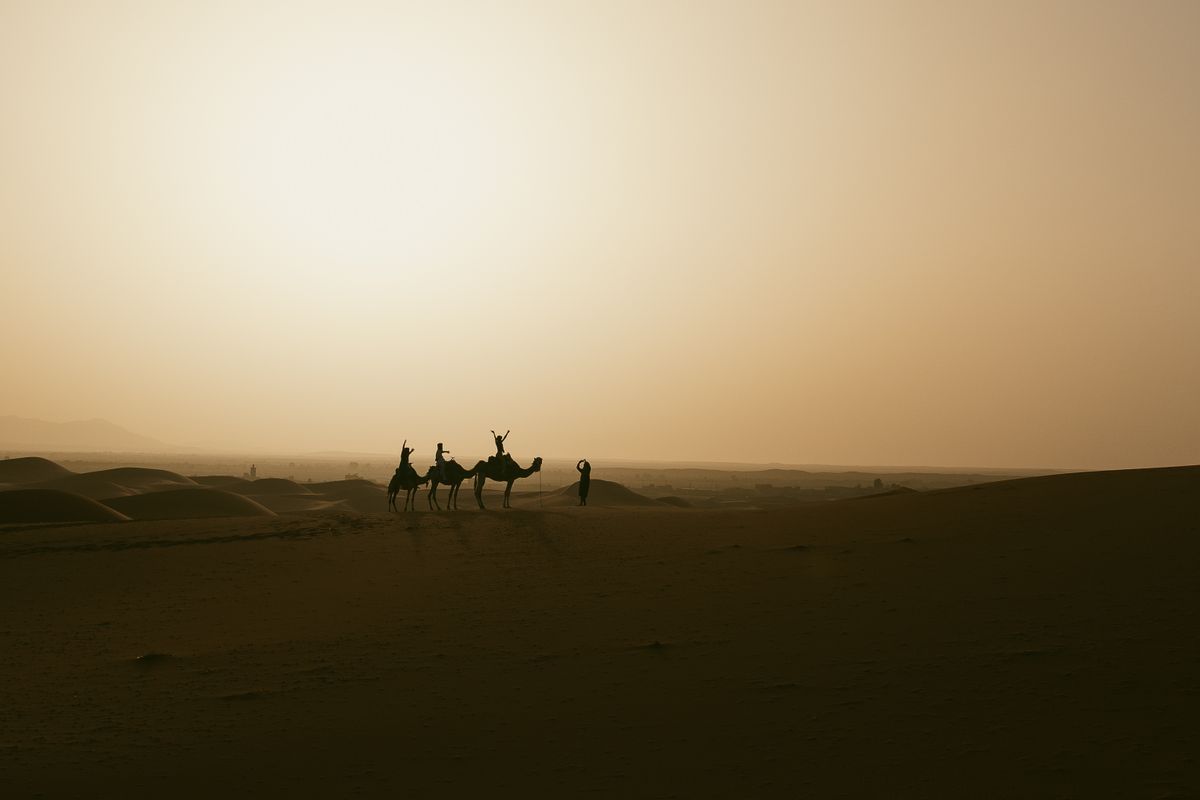
Dinner was simpler than the tagine from the drive in, a smaller vegetable version and more harira, plus flatbread again, all of it eaten around a low table with everyone reaching in rather than being served a plate each. The camel that brought us out there had opinions about being tied up for the night and let the whole camp know it. Nobody else seemed to mind.
I didn't come away from this trip thinking I need to change how I cook, my cart runs on speed and a flat pan and that's not changing. But I'd put a clay lid over my braise once, just to see. The tea, though, I'm stealing the height pour. My tea at home has been getting poured straight down into the glass like I'm filling a bucket, no wonder it's never had that foam on top. Eight out of ten for the whole night, and that's before you account for the stars, which I'm told don't count toward the food score but which I'm mentioning anyway. ■