Jeju's Volcano Coast in Orange, Black, Grey and Green
Jeju's volcanic coast in four colours: a sunrise peak, black boulders, grey lava columns and a green slope.

Panel 1: Orange (wide establishing shot)

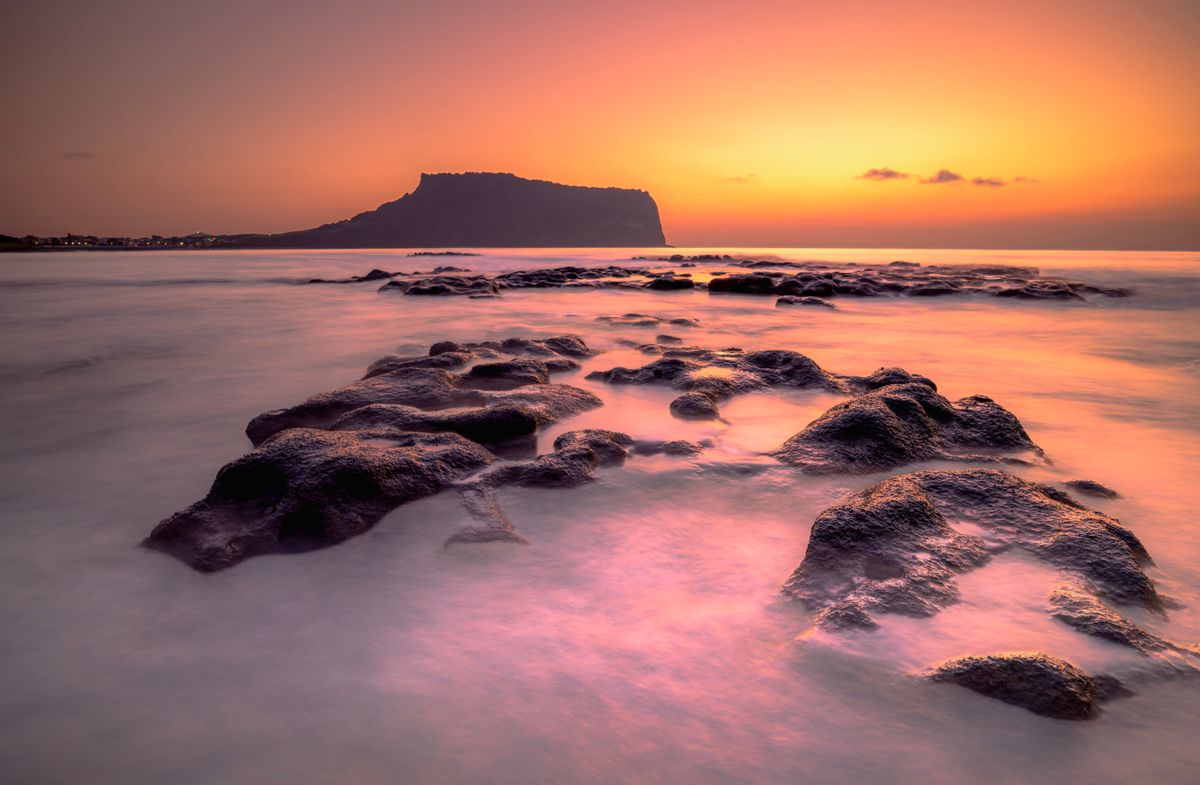
Low sun, long cloud
This is Jeju, South Korea's largest island, which consists chiefly of basalt and lava. At first light the sky is orange down to the horizon and the sea has gone to a pink haze, while one flat-topped peak stays black against both. That peak is Seongsan Ilchulbong, and Ilchulbong means sunrise peak. People come to Jeju's volcanic coast for that peak and for the dark rock the lava left along the shore.
Seongsan Ilchulbong is famed for being the easternmost mountain on Jeju, which makes it the best spot on the island to see the first sunrise of the year. Once the sun is up the palette cools to grey-teal, and only the streaks of cloud nearest it stay peach.
Behind me, the loudest sound all morning is a flask lid unscrewing.

Panel 2: Black (wide shot)
On Jeju's basalt coast the boulders sit in one wide black band between the grass and the sea. A single boulder, round and black and going nowhere, wouldn't make the page. The band of them would, because the yellow flowers in the grass and the deep blue water behind only look that bright against so much black.
Jeju formed from volcanic eruptions about two million years ago, and dark volcanic rock is the ordinary view along its coast.
Close to the water, each wave that pulls back through the rounded stones leaves a dry knock behind it, and the shore goes quiet until the next one comes in.
Panel 3: Grey (close-up)
From above, this ledge at Daepo Jusangjeolli, a cliff on Jeju's southern coast, is one dark grey slab pushing into grey-blue water. Its top is cracked into angular blocks, and its side faces drop to the sea as upright columns.
Those upright columns gave the cliff its name: jusangjeolli is the Korean term for columnar jointing. The cliff formed after lava from Hallasan, the volcano that is the highest mountain in South Korea, flowed into the sea.
A man next to me stayed looking down at the ledge for a long while after the people he came with had given up on it and walked on.

Dark grey rock ledge
"Grey on grey," he said, to nobody.
Panel 4: Green (splash page)
From the field at its foot, Seongsan Ilchulbong looks like a wall of dark crags above a green slope, and that suits the first half of its name, because Seongsan means fortress mountain.
Inker's notes
From November to February, Seongsan Ilchulbong opens an hour before sunrise and closes at 8 p.m.
The climb up the wooden staircase to the top takes up to 30 minutes.

The peak stands 182 metres tall, less than a tenth of the height of Hallasan, which rises 1,947 metres. At its top is a grassy crater.
An older name for the peak, Cheongsan, means green or blue mountain. ■