What the Cracks Admit in Giriloyo
A batik dyer travels to Yogyakarta's oldest batik village and checks whether its cracks were earned.
Waxing
The crackle on a length of cloth pinned by the workshop door ran fine and irregular, tighter along the hem than across the shoulder, the kind of pattern that shows up when a folded length sits too long before the wax cures all the way through. Someone worked this piece by hand and got tired near the end of the roll. I hadn't even taken my shoes off yet.
Kampung Batik Giriloyo sits in Wukirsari village, Imogiri district, Bantul Regency, about 15 kilometers from central Yogyakarta down a road that climbs through teak groves before dropping into the valley. It is considered the oldest batik-writing craft center in the region, with the tradition dated to the seventeenth century, and more than 540 craftspeople work here today, most of them women who learned the canting the way most of us do: watching over someone's shoulder for years before anyone let them near good cloth.
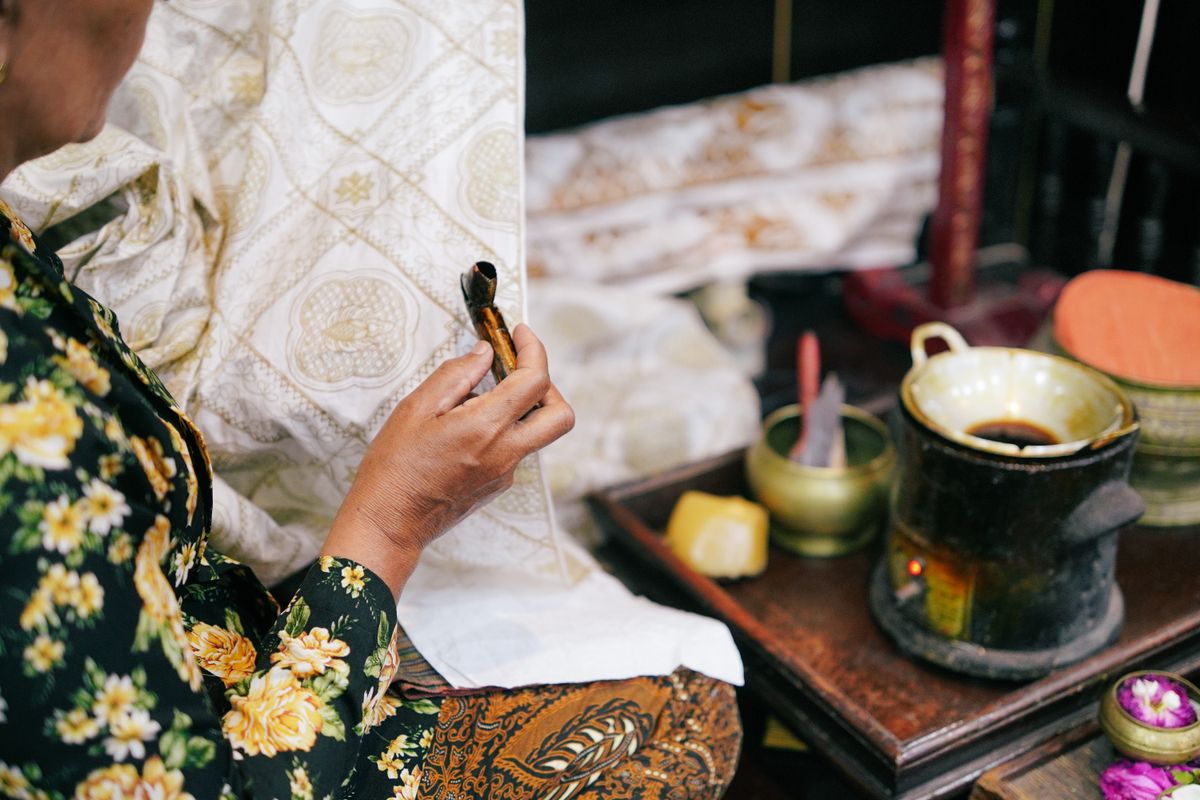
The tool itself is called a canting: a small copper reservoir on a wooden handle that holds melted wax and lets it flow through a narrow spout. Tulis means every line on the cloth came from that spout moving under a human wrist, one stroke at a time. Cap uses a carved copper stamp instead, pressed down again and again for speed, and machine-printed cloth skips wax altogether, which means it skips the part that actually makes a pattern batik. I can tell tulis from cap in about two seconds, and either of them from a print in about half that, mostly by how bored the lines look.
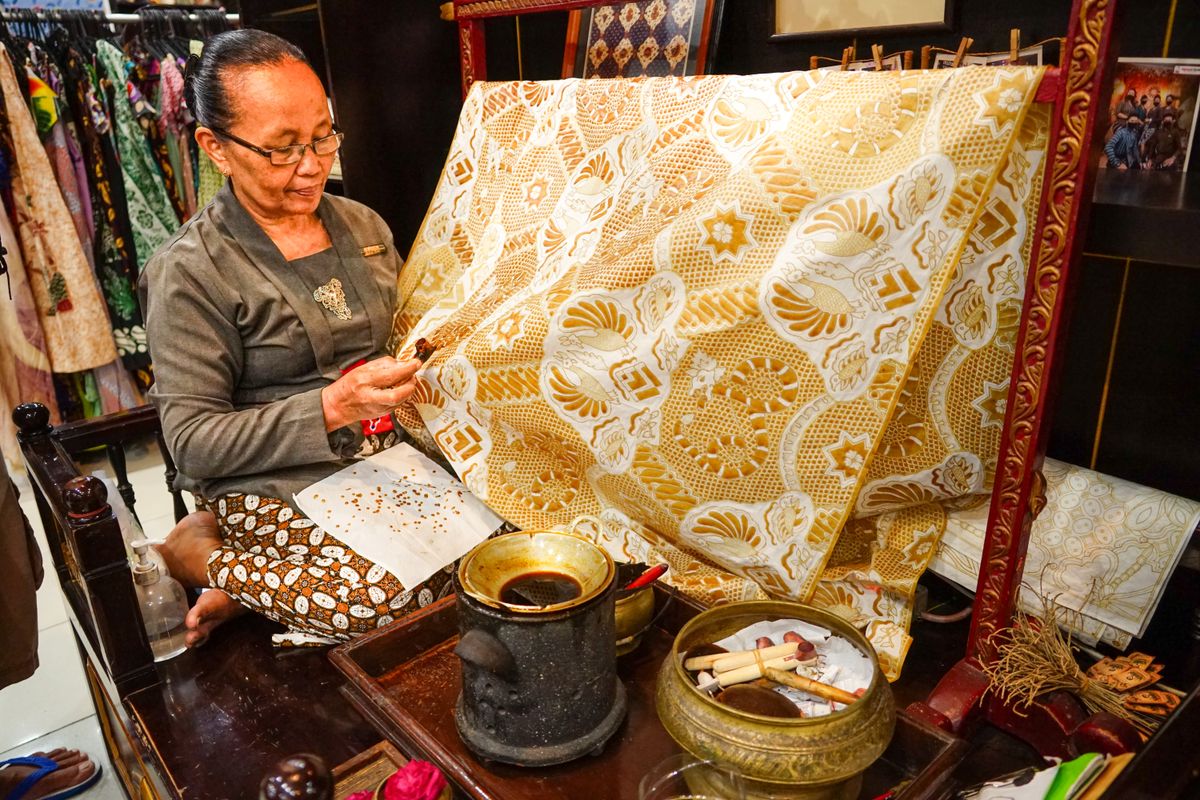
By early afternoon the air over the pavilions gets heavy enough that wax cools slower than it should, and a canting that ran clean at nine in the morning starts leaving fat little blobs at the end of each stroke by two. The woman working the gold cloth switched to a smaller-spouted canting without breaking her line, which told me she had fought this exact humidity a thousand times before.
I checked her repeat against itself anyway, holding two motifs a half-meter apart up to the light. They matched within a millimeter, and for a free hand working without a stencil, that kind of symmetry only comes from drawing the same shape so many times the hand stops thinking about it.
The crackle by the door, once I looked at it straight on, ran evenly through both directions of the weave, with no clean repeat that would give away a stamp. Hand wax, earned the ordinary way: a morning, an afternoon, and by the ragged bit near the hem, a night finishing under a bad lamp.
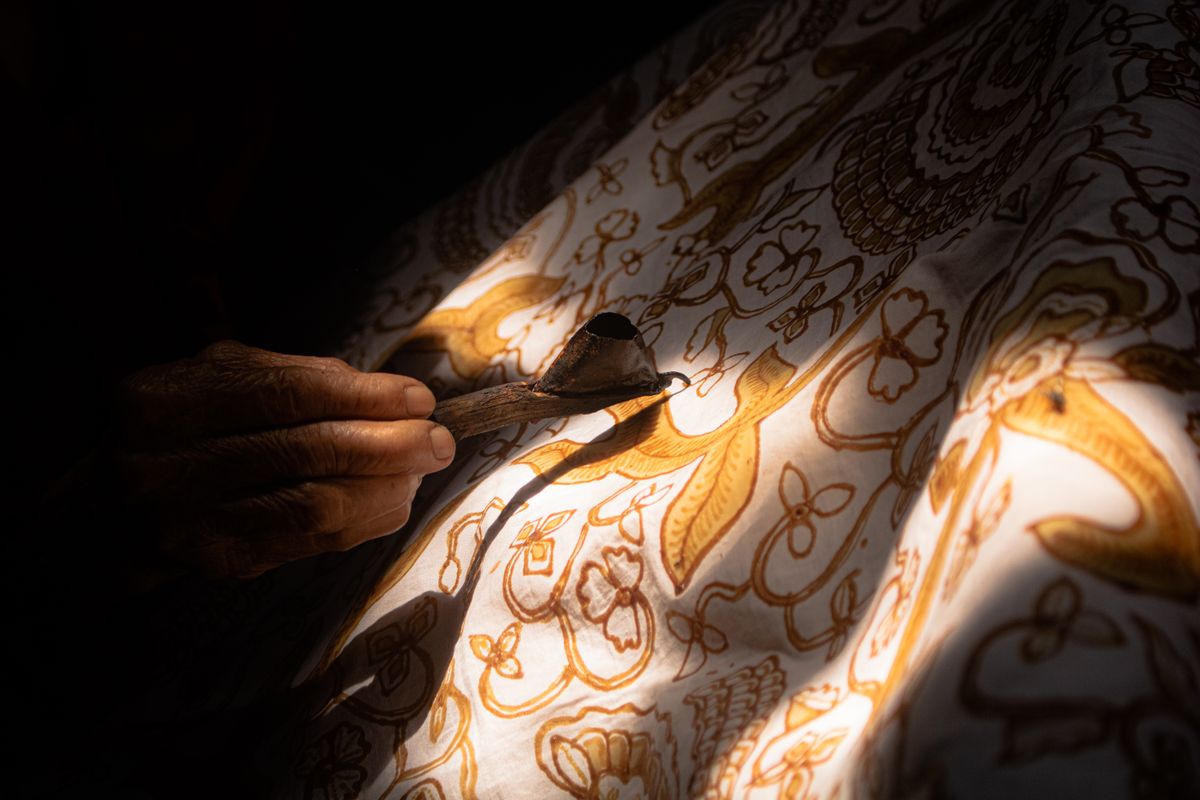
A canting doesn't lie about how tired your hand was by the third hour.
— workshop notes
Dyeing
dyer's notes
Wear clothes you don't mind staining, the wax and dye both find their way past an apron.
Going alone costs less per person than joining a group of five, oddly enough, so don't assume the group rate is the discount.
Ask who taught the motif you're drawing. If the only answer is 'it's traditional,' that is worth noting, not repeating.
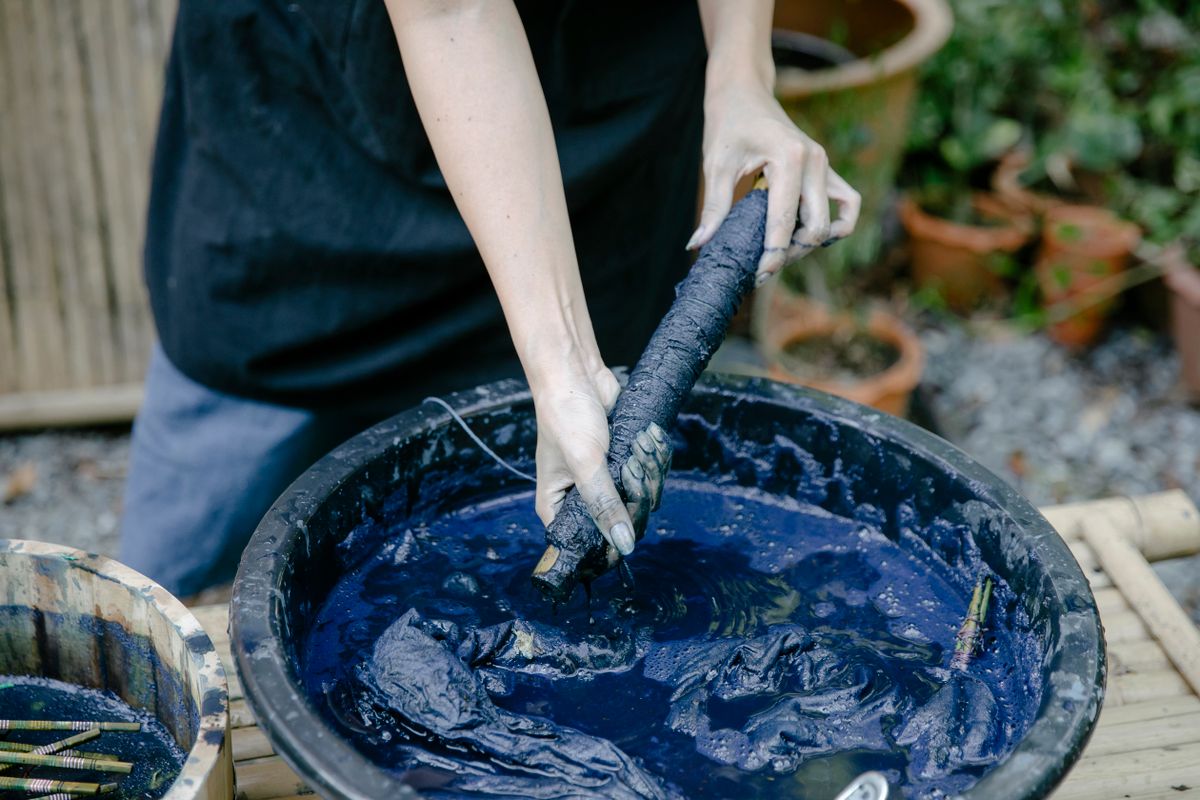
The indigo stain on my own thumbnail was still visible from home, three days old and gone from blue toward black, which is roughly how long a hand carries the dye before ordinary washing gets it out. At Giriloyo the vats sit in a shaded courtyard behind the pavilions, four of them in a row, each one a slightly different shade of near-black depending on how many lengths of cloth have gone through since it was last topped up.
A visitor can book a session alone or with a group, and it runs about an hour and a half to two hours depending on how much of the pattern you draw yourself before the cloth goes into the vat. It costs from around Rp25,000 per person alone, or Rp250,000 for a group of five, a higher price per head for the group, oddly, though you do get more elbows around the frame and someone else to blame if your line wanders.
The motifs taught here follow the classical patterns of the Mataram court, and each one supposedly carries its own meaning, the kind of claim guides repeat to every group without checking further. I asked the woman running my station where she actually learned which meaning went with which pattern, and she said her grandmother told her, over years, cloth by cloth. That is a real answer, not a decorative one, and worth more than the word traditional gets used for at most places that sell this cloth.
The cloth that had gone through four dips came out even across its whole surface, no pale patches where wax had cracked and let dye creep under the resist too soon. Some patterns build that kind of bleed in on purpose, but not the ones taught at Giriloyo. Here it just meant somebody had waxed carefully. No hidden virtue in it, just a good hand.
Boiling-out
Wax that has been through only one dye bath comes off the cloth almost white in the boiling water. After several rounds of waxing and redipping, it comes off the color of weak tea instead, carrying out the layers of dye it sat under. The pot behind the last pavilion had already gone that color by midmorning, which meant a full day of other people's cloth had gone through before mine got anywhere near it.
Giriloyo workshop, per session
Boiling-out is where a piece either proves itself or does not. The wax melts free in the hot water and the pattern that sat invisible under white wax for two days finally shows itself against the dye, and any place the wax cracked wrong or lifted too early shows up as a smear instead of a line. Nothing about this stage forgives a bad morning.
I ran a thumb along the finished pattern where the wax had just come free, feeling for stiff patches that would mean residue left behind, the kind that turns brittle and cracks unevenly within a year. This length came away clean.
Walking back toward the road I passed a stall selling scarves stamped with a crackle pattern printed in gray ink to look like aged wax, sold as tulis to anyone who did not ask further. The lines repeated every twenty centimeters in identical little forks, the kind of regularity a human wrist never produces even on a good day. Fake crackle, printed to make a machine look tired. Nobody at the stall seemed bothered when I said so, and neither was I.
I did not buy the printed scarf. Nothing else came home with me either, since a dyer's suitcase is already heavier than it looks, with wax stains that never fully wash out of the good shirts. The cloth I made stays in Wukirsari to finish curing before it is mailed, and I will know in about a month whether my line held steady through that one humid afternoon, or whether it went soft near the end like every other roll eventually does. ■