A Day on the Bog Boardwalk in Lahemaa
Walking the planks across a raised bog in Lahemaa, Estonia, with a manor and the coast for the afternoon.

The boardwalk is at the rough-out stage, planks down and nothing sanded, and it runs out across flat green ground toward a low line of pines. We were in Lahemaa, a national park on the north coast of Estonia. The planks cross a raised bog, wet ground that has built up higher than the land around it.
Out on the planks, with the cloud piled up dark and white over the bog, a woman coming back the other way stopped to let us pass and nodded at those pines. "They always look closer than they are," she said, and kept going. She was right, because we walked a long way after that before the pines looked any bigger, and the cloud kept building, though it never rained.
An early start
Tallinn, the capital of Estonia, is 70 km west of the park, and my brother had us on the road early on a summer morning because he wanted the bog before the day warmed up. Mist still lay over it when we parked, and he took that as proof the early start had been worth it. It had burned off before we reached the first pool.

The boardwalk
I looked at the boards the way I look at timber before I carve it, and the low sun helped, because it raked along the planks and showed the grain running the length of the walk. They are sawn boards, and the surface has gone a dark grey where years of sun and rain have worked on it, long past the point where anyone would plane it again. Each step gave a hollow knock. Sedge, a grass-like plant that grows in tufts, comes right up to the edge, so a step sideways puts a foot in the wet.

Workshop notes: each step on the planks gave a hollow knock.
From the pool to the coast
The clouds had come up by the time we stopped at a pool, and with no wind they showed in the water almost as clearly as they did overhead. A bog gets all its water from rain and snow, so nothing reaches a pool like this from streams or from the ground underneath.
carver's notes
Several companies run day tours from Tallinn, and many people drive themselves.
The park covers 747 square kilometres, 274.9 of them sea, so pick two or three stops and leave the rest.
Palmse has several preserved outbuildings, including a distillery, a greenhouse and a barn, and a park with romantic pavilions and a bath-house.
Sagadi's manor house has painted ceilings and is historically furnished, with 20 outbuildings and a park around it.

Under the moss and the tussocks lies peat, the half-rotted plant remains that pile up in wet ground. Every bog starts out as a fen, a wetland that can be slightly acidic, neutral or alkaline, and may turn into a bog once the peat rises above the land around it, after which it is always acidic and nutrient-poor. Lahemaa has many raised bogs, and one of them, the Laukasoo Reserve, is 7,000 years old.
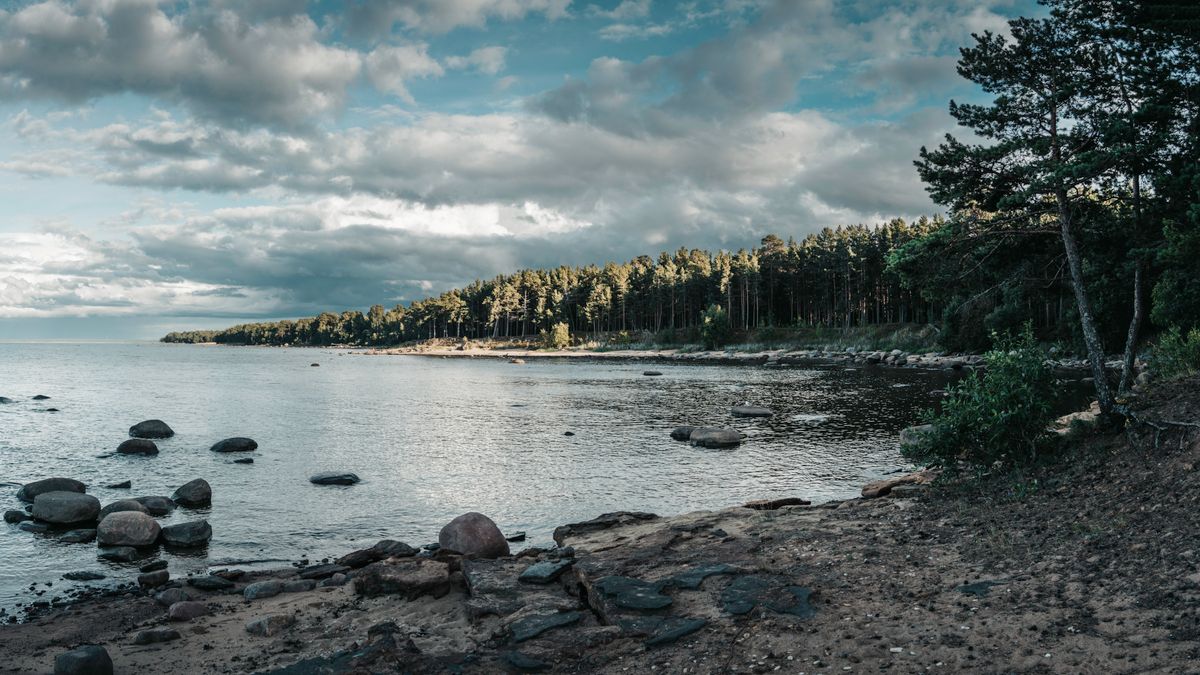
We gave the afternoon to a manor and the coast. Manors here are the country houses of landowning families, and ours was Palmse, one of four in the park, owned by one family from 1676 until 1919. My brother wanted more time on the shore, so Sagadi, the most visited manor in Estonia, stayed a name on the map. Along that coast four large peninsulas are separated by four bays, which is where the park gets its name, roughly Land of Bays. Cranes stop over on the rocks and boulders of that shore each year on migration. ■